

Africa Cup of Nations 2025: What it says about Africa

Chaimaa Radouani is an external PhD candidate at the African Studies Centre Leiden, where she researches the migratory ambitions and pathways of sub-Saharan African migrants in Morocco, particularly Nigerian migrants. Her research focuses on the moment when migrants realise that Morocco is no longer just a transit point to Europe, but a place where they choose to settle permanently.
The Africa Cup of Nations (AFCON), held in Morocco last December and January, ended in a chaotic final between Senegal and Morocco. AFCON was born in 1957, at a moment when African unity was both urgent and fragile. It provided recognition and a stage to imagine the continent differently. However, those ideals were tested almost immediately. The tension between unity and division has not disappeared over time.
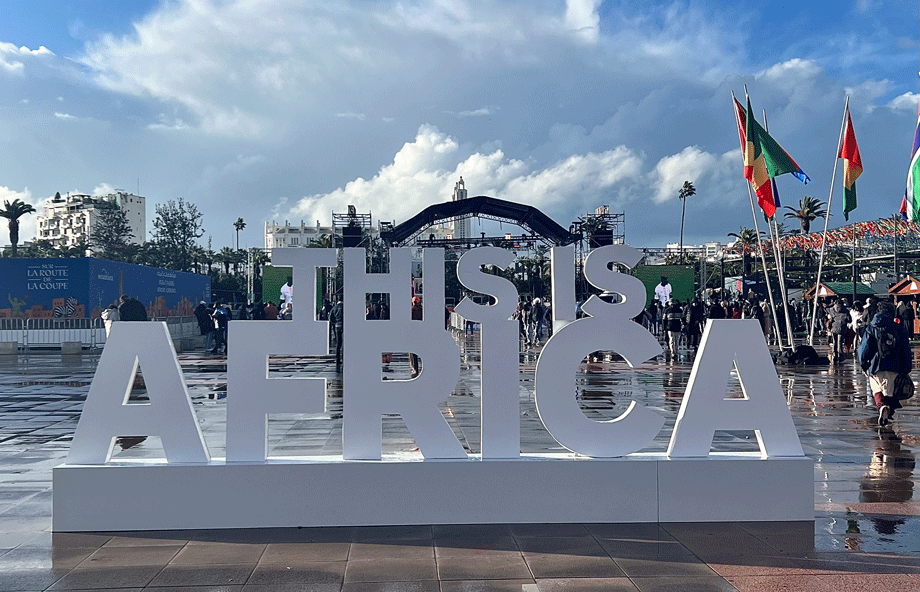
If you happened to be in Morocco between 21 December 2025 and 18 January 2026, or even slightly before, the atmosphere felt different than usual. African flags fluttered from balconies and cafés, draped over taxis, printed on scarves, painted on cheeks. The familiar red Moroccan flag that usually dominates every corner was suddenly sharing space with dozens of others. Train stations and airports were more crowded than usual, city centres filled with travelers rolling suitcases over cobblestones, scanning Google Maps for hotels or pausing outside restaurants whose menus left them undecisive. Conversations shifted languages every few meters. You did not need an official announcement to know something significant was happening: The Africa Cup of Nations (AFCON) was being held in Morocco. The tournament appeared just as much in stadiums as it did in daily life and digital spaces. YouTube ads looped highlights of Moroccan players with cinematic music and patriotic slogans. Billboards stretched across highways presenting football as an emblem of identity rather than just a sport. Marketing campaigns flooded streets, screens, and social media feeds, blending national pride with commercial messaging. Jerseys became everyday clothing, cafés replayed goals on repeat, and football quietly moved from being an event to becoming a cultural centre of gravity. For a few weeks, Morocco reorganised the AFCON’s rhythms, its visuals, and even fragments of its self-image around the game.
Stand as equals
If we look at the AFCON historically, it was born in 1957, at a moment when African unity was both urgent and fragile. At a time much of the continent remained under colonial or imperial control or breaking free from it, long before the Year of Africa in 1960, when many countries finally gained sovereignty. Borders, languages, and institutions imposed by European powers (and sustained by imperial networks) still shaped daily life, and political sovereignty was uneven at best. Football was one of the few spaces where African nations could stand as equals. AFCON provided recognition and a stage to imagine the continent differently. It was a space where fans and players could express collective pride despite divisions imposed from outside. However, those ideals were tested almost immediately. Take Apartheid South Africa: when the country insisted on sending an all-white team, the AFCON expelled it and banned it from playing, forcing it to miss eighteen tournaments and only returning in 1994. The ban sent a clear message: African solidarity could be enforced. But it also revealed vulnerability: unity depended on political will, and from the very beginning, AFCON had to navigate between aspiration and reality. It had to balance ideals of cohesion against structural inequalities inherited from imperial and colonial rule.
Lumumba’s iconic pose
This tension between unity and division has not disappeared over time. Decades later, it resurfaced dramatically at AFCON 2025 in Morocco. During all of DRC’s games, Michel Nkuka Mboladinga, a fan from the DRC, imitated Patrice Lumumba (the revolutionary first prime minister of the independent Democratic Republic of the Congo) raising his arm in the iconic pose immortalised on Lumumba’s Kinshasa statue. Lumumba’s anti-colonial vision and insistence on African solidarity elicited a strong response across sub-Saharan and North Africa, thereby establishing football as a space for Pan-African ideals. Even symbols of resistance proved tenuous: After the DRC’s loss to Algeria, an Algerian player mimicked Mboladinga’s gesture and collapsed to the ground as if Lumumba himself had fallen. Apologies followed, but the episode highlighted how African symbols can be contested: even revered anti-colonial figures can become props for rivalry and spectacle. This says something about how icons of collective struggle are easily turned into pawns in competitive nationalism, and it also speaks to the limits of Africanness in a continent still haunted by imperial and colonial legacies.
 The pressures of commercialisation
As battles over identity unfold on the pitch, media and money have begun to shape the game too; which adds new layers to Africa’s ongoing tensions between unity and division. In other words, the political and symbolic stakes of AFCON now mix with the pressures of commercialisation. Sponsorships, branding, and media presence now structure the AFCON as much as football itself. Corporate logos dominate stadiums, national teams circulate as marketable images, and players move through global circuits where African talent fuels international leagues. Some sponsors, like the Russian-founded online betting platform 1XBET at AFCON 2025, are evidence of how financial pragmatism intersects with geopolitical influence. Football continues to speak the language of unity; but now that language passes through the filters of profit, exposure, and global reach.
Serving elites
The 2025 tournament also revealed limits in access and inclusion. Morocco’s stadiums, infrastructure, and organisational capacity were on full display. Cities like Rabat, Casablanca, Marrakech, Fes, and Tangier projected competence and soft power across Africa. Yet a survey by L’Économiste in partnership with Sonergia found that 92% of Moroccans did not attempt to purchase tickets. Only younger, urban residents tried - and among them, 52% found the process difficult, while nearly half considered prices unaffordable. Football, in this sense, served elites and commercial interests more than popular participation. The spectacle dazzled, but for whom?
Racial tensions
The chaotic final between Morocco and Senegal brought these contradictions into sharp relief. Contested referee decisions, walk-offs, security interventions, attempts by some Senegalese fans to force entry onto the pitch, and clashes in the stands transformed the match into a scene of mistrust rather than celebration. Senegal won 1–0 in extra time, yet the score mattered less than the tensions on display: unity gave way to suspicion, rivalry, and resentment. Allegations that the match was rigged and that rules had been selectively enforced circulated widely, while violence extended beyond the stadium into streets and digital spaces. Racial tensions also resurfaced and were amplified online. Social media platforms became sites where misinformation, fake accounts, and coordinated bot activity intensified nationalist and racist rhetoric. Insults, memes, and exclusionary narratives circulated rapidly, contributing to incidents of violence against Moroccan students in Senegal and renewed anti-Black racism in Morocco, particularly targeting sub-Saharan African migrants. Regional alliances shifted fluidly across digital spaces, while narratives distinguishing between ‘deserving’ and ‘undeserving’ Africans spread widely. These dynamics exposed hierarchical imaginaries rooted in imperial and colonial histories, even if not entirely determined by them. Ultimately, these divisions raise pressing questions: Who benefits from fragmentation? Who profits from the circulation of hate? Certainly not Africa.
The scramble for Africa
This is nothing new. By the 1870s, European powers were already eyeing Africa’s resources. The Berlin Conference of 1884 formalised the scramble: twelve European nations, alongside the United States and the Ottoman Empire, carved up the continent like a cake, leaving little room for African voices. Imperial ambition and the logic of exploitation shaped borders, institutions, and economies, and their consequences remain visible today in languages, governance systems, education structures, and the marginalisation of African knowledge production. The same forces that once profited from dividing Africa continue to benefit from its fragmentation (though through different mechanisms). Wars and colonial treaties have largely been replaced by financial interests, emotional mobilisation, and global (in)visibility, with football emerging as one of the arenas where these dynamics unfold. AFCON once challenged that legacy by offering a space to rehearse collective belonging and Pan-African solidarity. Today, however, the tournament is shaped as much by spectacle, commercial sponsorship, and hyper-nationalist competition as by continental pride. As economic interests, media narratives, and geopolitical actors increasingly influence the tournament, AFCON risks reproducing the very fractures it once sought to transcend. In a continent where imperialism profited from division, can we afford to let the game do the same again?
Theatre of power
This AFCON reflected Africa’s fracture. What appears to be mere sport, an arena of entertainment, is in fact a microcosm: a space where bodies are displayed and turned into symbols, divisions are contested, identities are performed, inequalities are laid bare, and the hopes of an entire continent play out under the floodlights. In many African contexts, football also becomes a site where hidden agency surfaces and emotions find release against the pressure of daily life. For ninety minutes, a hero is born and an enemy is named; forms of symbolic equity that everyday life rarely grants. Communities search for meaning through the game, collectively imagining which nation is strong, which is healthy, which is advanced; which makes them invest more emotion in stadiums and pour more passion into live broadcasts than they do in schools or hospitals. What looks like leisure is therefore never just leisure; it is a condensed theatre of power, desire, memory, and possibility.
Would you like to comment? Please do! The ASCL reserves the right to edit, shorten or reject submitted comments.
Also check out the Library Weekly about the 2025 Africa Cup of Nations.
Photos by Chaimaa Radouani.
Top photo: This is Africa, taken in Casablanca.
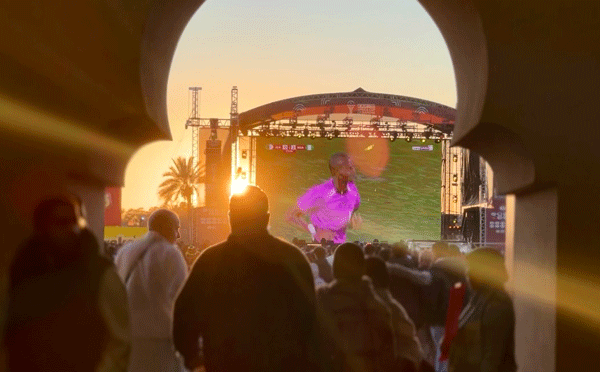
Lower photo: Fan zone in Marrakech during the Nigeria vs Algeria game.
Posted on 13 February 2026, last modified on 20 March 2026