

Beyond Books: Reflections from a professional exchange at the African Studies Centre Leiden

This blog was written by Aba Amandzewaa Anaman, Head Librarian, Institute of African Studies, University of Ghana. Ms Anaman was a visiting librarian at the ASCL in August-September 2026.
From 23 August to 7 September, Aba Amandzewaa Anaman, Head Librarian of the Institute of African Studies, University of Ghana, undertook a professional work exchange with the African Library in Leiden to share ideas and experiences. One of her reflections: African Studies libraries should be partners in deciding how Africa is documented, described, preserved and represented.
I arrived in Leiden with several questions. How does a specialised African Studies library build a collection that is both comprehensive and representative? How can African scholarship be made more visible? How can libraries balance print and digital collections, donations and deliberate acquisitions, preservation and access? And, importantly, how can African libraries and African Studies libraries elsewhere in the world learn from one another? Over the two weeks, these questions became the basis for many conversations, practical sessions and moments of reflection.
 Looking beyond the shelves
My programme began with an introduction to the ASCL, meetings with staff and a tour of the African Library. What immediately stood out was that the work of the library extends far beyond acquiring books and placing them on shelves. Sessions during the exchange covered archives, collection development, ordering and cataloguing, electronic books and resources, subscriptions, publications, indexing, the African Thesaurus, digital services, social media, web dossiers and other approaches to making collections discoverable. The programme also introduced me to the African Literary Metadata Project, ALMEDA, and the Ustadh Mau Digital Archive, UMADA.
One particularly interesting aspect of ALMEDA was its attempt to address the invisibility of African literary works that may never appear individually in conventional library catalogues. Poems, short stories, plays and other works published within journals, magazines and other containers can easily remain hidden because libraries traditionally catalogue the publication rather than every individual work within it. ALMEDA demonstrates how metadata and digital technologies can be used to bring such works into view. For me, this raised a larger question: how much African knowledge remains invisible, because our systems have not adequately described, indexed or connected people to it?
 Rethinking collection development
Collection development was one of my main interests during the exchange. At the Institute of African Studies Library in Ghana, donations form an important part of our collection. While these donations are valuable, they also raise practical questions about relevance, space, duplication and how far a collection should be shaped by what is donated rather than by clearly identified priorities.
My discussions with the collection specialists at the African Library therefore provided an important opportunity to compare experiences. I was particularly impressed by the deliberate effort made by the African Library to identify and acquire materials published in and about Africa, including materials that may not be readily available through mainstream international suppliers. This requires considerable effort. Staff have to identify publishers and vendors, maintain contacts and, in some cases, acquire materials directly from African countries.
At the same time, the discussions revealed that no collection is ever complete. Questions remain about language, geography, formats, whose voices are represented and what kinds of knowledge are considered worthy of collection. These issues came together during the Collection Development Workshop on 1 September, which centred African perspectives. Our conversations went beyond the simple question of whether a library has materials about Africa. We considered deeper questions: Which Africa is represented? Who is speaking? Which regions, communities, languages and publishers are visible? Who is missing?
We also discussed the importance of moving beyond token representation towards meaningful partnership with African librarians, researchers, publishers and communities. Developing an African collection should not simply mean collecting about Africa. It should increasingly involve collecting with Africa. This was one of the strongest reflections I took from the exchange.
 Archives, preservation and the memory of institutions
My introduction to the ASCL archives provided another important area of learning. The archive includes institutional records as well as research materials and personal archives, including the extensive Stephen Ellis Archive. The discussions around these collections highlighted the importance of preserving not only published scholarship but also the primary materials behind research: correspondence, field notes, interviews, recordings, photographs and other documentation.
This resonated strongly with our work at the Institute of African Studies in Ghana, where archives and special collections preserve important aspects of Ghanaian and African intellectual and cultural heritage. The experience reinforced my belief that African Studies libraries must increasingly think of preservation in a much broader sense. Books remain important, but photographs, oral histories, sound recordings, films, research data, grey literature and born digital materials are equally part of Africa's scholarly and cultural record. Digitisation is therefore not simply about converting paper into digital files. It is about deciding what deserves to survive, how it should be described, how it can be discovered and, importantly, who should have access to it.
Making collections visible
Another important lesson concerned visibility. A library can have an excellent collection, but if users do not know that the material exists, its value is diminished. At the African Library, I learnt about the different ways staff use the website, Library Highlights, newsletters, subject indexing, alert services and other digital products to draw attention to the collection.
This prompted me to think more critically about how we communicate the value of our own collections at the Institute of African Studies Library. The lesson for me was simple: collection development does not end when an item is acquired and catalogued. Libraries must continuously connect collections to people. This may mean creating online features around particular resources, highlighting new acquisitions, developing thematic guides, using social media more strategically or creating programmes around audiovisual collections. A documentary, for example, can become the starting point for a discussion, exhibition or film screening that directs participants to books, archives and other resources on the same subject. In this sense, outreach is not separate from librarianship. It is increasingly central to it.
Sharing experiences from Ghana
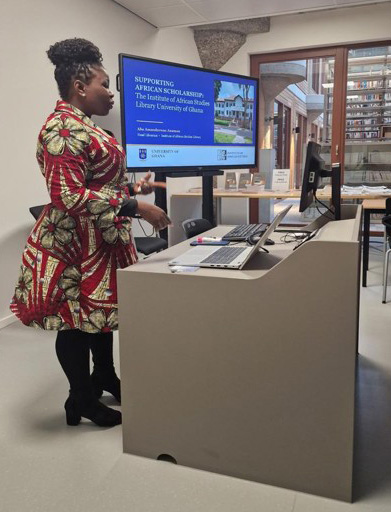
An important feature of the exchange was that learning went in both directions. On 31 August, I gave a presentation during the ASCL Week Opening titled Supporting African Scholarship: The Institute of African Studies Library, University of Ghana. I introduced colleagues to the history and work of the Institute of African Studies Library, our collections, research support services, preservation activities, innovations and some of the challenges we face. It was an opportunity not only to showcase our work but also to place the Institute within a wider conversation about African scholarship and the responsibility of African libraries to preserve and make our intellectual heritage accessible.
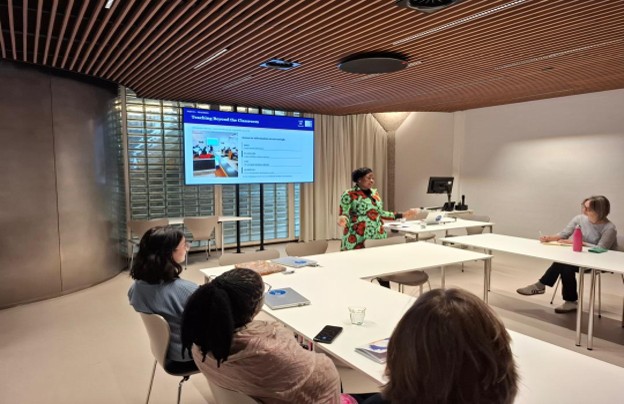
On 3 September, I participated in an interactive session with Leiden University Libraries colleagues titled Being an Academic Librarian in Ghana: Experiences, Innovations, and Lessons from the University of Ghana. The conversations surrounding these presentations reminded me that professional exchange is most valuable when knowledge does not travel in only one direction. Libraries in Europe have practices and resources from which African institutions can learn, but African libraries equally possess experiences, knowledge, collections and perspectives that can enrich institutions elsewhere. Our contexts may differ, but many of our professional questions are remarkably similar.
Beyond the African Library
The exchange also provided opportunities to engage with the wider professional environment in the Netherlands. A visit to the National Library of the Netherlands in The Hague provided another perspective on collection management, preservation and the responsibilities associated with maintaining knowledge resources at national level. I also had opportunities during my stay to engage with professionals beyond the immediate African Library environment. These encounters broadened the experience from one centred on a single institution to a wider reflection on librarianship, knowledge preservation and international professional cooperation.
Just as valuable were the informal conversations during lunches, coffee breaks and other interactions. Some of the most useful professional exchanges do not happen during formal presentations. They happen when colleagues compare experiences, ask questions about each other's institutions and discover that a challenge that appears unique to one library may be familiar to another.
What can we learn from each other?
One of my strongest impressions of the African Library was the dedication involved in building and maintaining a specialised collection on Africa. Staff actively seek materials, develop metadata, provide research support, promote collections and continually consider new ways of connecting resources with users.
At the same time, my experience from Ghana brought another perspective to these conversations. African institutions are not simply sources from which materials can be collected. They should be partners in deciding how Africa is documented, described, preserved and represented. This is particularly important when discussing African languages, indigenous knowledge, local publications, oral histories, grey literature and materials produced outside mainstream commercial publishing systems. Some of the richest sources for understanding African societies may never reach the conventional international book trade. If African Studies collections are to represent Africa in its complexity, partnerships with institutions and professionals on the continent are essential.
Taking Leiden back to Ghana
I returned to Ghana with many ideas, but perhaps more importantly, with new questions about my own practice. How deliberately are we building our collections? What unique materials do we hold that need urgent preservation? How visible are our collections beyond the physical walls of the library? How can we strengthen our digitisation activities? How can we make our research support services more responsive? And how can we build partnerships that allow African knowledge to circulate without separating it from the institutions and communities that produce it?
One practical outcome of the visit was my renewed determination to strengthen digitisation and preservation at the Institute of African Studies Library, particularly for rare and deteriorating materials. I also returned with ideas for improving collection visibility, reviewing our approach to donations, strengthening collection development priorities and exploring more creative ways of bringing our resources to the attention of researchers and students.
Not everything I observed in Leiden can or should simply be reproduced in Ghana. Our institutional contexts, resources and user communities are different. The real value of the exchange lies in identifying practices that can be adapted to our environment while also recognising what our own experiences can contribute to the wider professional community.
More than a professional visit
Looking back, the exchange was about much more than observing how another library operates. It was about relationships, representation and the shared responsibility of libraries to ensure that knowledge is not only preserved but can also be found, accessed and used. It also reinforced for me that the future of African Studies collections must be built through collaboration. Libraries in Africa and African Studies libraries elsewhere have much to gain from sustained dialogue, joint projects, knowledge sharing and professional exchanges.
I left Leiden with a deeper appreciation of the African Library’s work, but also with renewed appreciation for the collections, expertise and possibilities we have at the Institute of African Studies and the University of Ghana. Perhaps that is the greatest value of a professional exchange. You travel to learn about another institution, but in doing so, you begin to see your own institution differently.
The challenge now is to turn those reflections into action and to continue building relationships through which African knowledge can be collected, preserved, made visible and shared in ways that keep African voices and perspectives at the centre.
Photos:
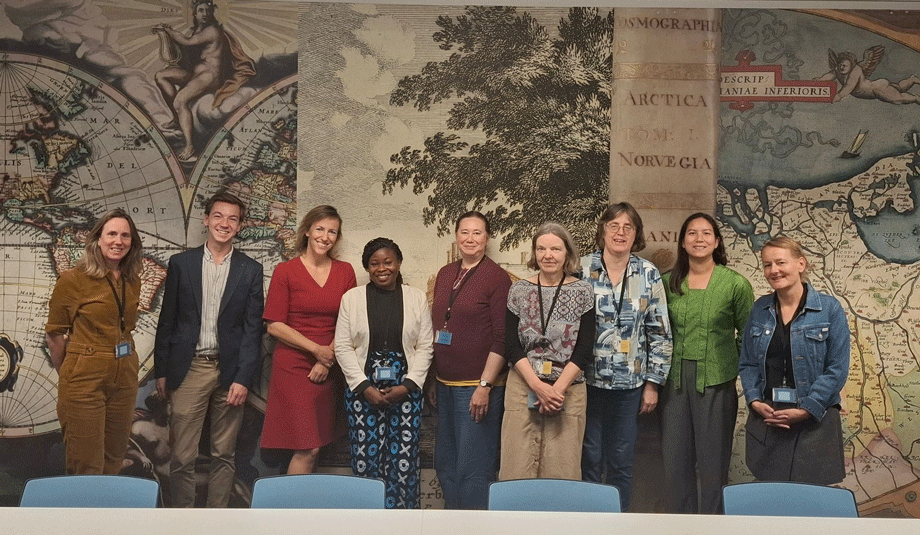
Top photo: Visit to the National Library of the Netherlands in The Hague: Liesbeth Kanis, Lucas Faessen, Maaike Napolitano, Aba Amandzewaa Anaman, Angela Robson, Heleen Smits, Machteld Oosterkamp, Louise Rahardjo, and Germa Seuren.
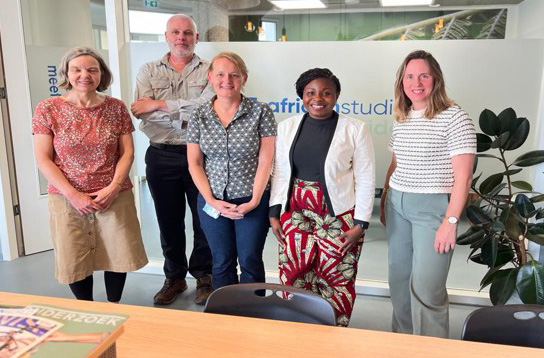
Top photo right: Aba with, on her left, African Library colleagues Heleen Smits, Gerard van de Bruinhorst, Germa Seuren, and, on her right, Liesbeth Kanis.
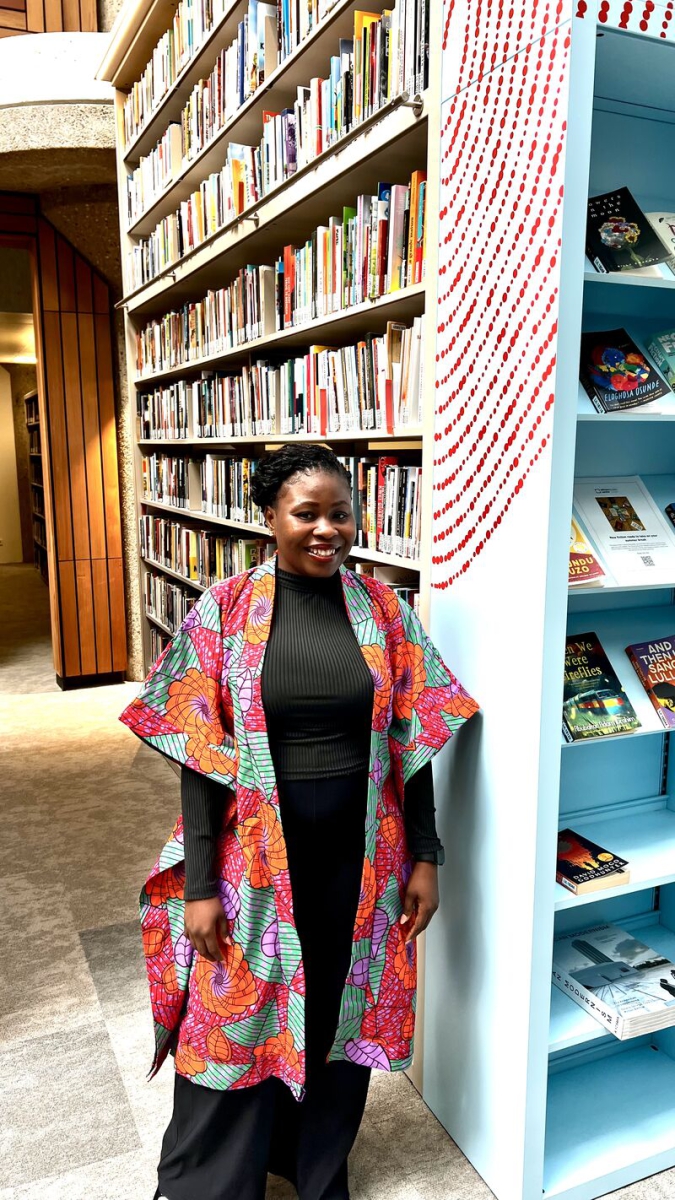
Top photo left: Aba in the African Library, Leiden.
Lower photo right: Aba during the ASCL Week Opening.
Lower photo left: Aba presenting for Leiden University Libraries colleagues.
Watch a short interview with Aba Amandzewaa Anaman on LinkedIn or Instagram.
Posted on 5 October 2026, last modified on 8 October 2026