

Beyond 'illegal foreigners': Why South Africa must rethink migration, legality and belonging

Tinashe Chimbidzikai is a PhD candidate with the Georg-August University of Gottingen and an external PhD candidate in the Graduate Programme of African Studies, African Studies Centre Leiden. The working title of his research is (Re-) production and imagination of urban social space by Pentecostal immigrants in South Africa: A narrative ethnography.
South Africa witnesses nationwide anti-immigration protests led by the group March and March, demanding the deportation of undocumented foreign nationals. Framed as a campaign to defend jobs, security and public resources for citizens, the protests tap into growing anxieties around unemployment, crime and state failure. Yet beneath these grievances lies a dangerous political habit of turning migrants into convenient scapegoats for structural crises they did not create.
South Africa has seen this before. In 2008, xenophobic violence left over 60 people dead, some burned alive. In 2015, similar violence resurfaced in Durban and Johannesburg, displacing thousands and reopening deep social wounds. The fear now is not merely that protests may occur, but that they may reignite a logic of exclusion that has repeatedly proven deadly.
Middle-class aspirations
This moment demands a more careful understanding of migration. My research on Zimbabwean migrants in Johannesburg complicates the dominant image of the ‘illegal foreigner’. I examine how migrants navigate precarious urban life while pursuing dignity, stability and social mobility. My interlocutors were not marginal figures living outside society. They occupied a wide range of sectors, including teaching, banking and finance, engineering, retail, tourism and hospitality. Others operated in the informal economy as traders, transport operators and small-scale entrepreneurs. What united them was not illegality, but middle-class aspiration. Most belonged to the middle class, or were actively striving toward middle-class futures. They invested in education, housing, remittances, church communities and professional networks. Their migration was not simply about survival; it was about crafting respectable futures amid Zimbabwe’s prolonged political and economic crises. This distinction matters because anti-immigration discourse often collapses all migrants into a single category of threat.
Such simplification is analytically flawed and politically combustible. It ignores the fact that many migrants contribute directly to South Africa’s economy through labour, taxation and service provision. It overlooks the structural role migrants play in sectors already dependent on their skills and labour. And crucially, it obscures how many become ‘undocumented’ not by criminal intent, but through legal and bureaucratic uncertainty. The Zimbabwe Exemption Permit (ZEP) is a case in point. For years, the ZEP offered temporary legal recognition to Zimbabweans who had established lives in South Africa. Many built careers, families and businesses under its framework. But the uncertainty surrounding its termination, and the protracted legal battles that followed, has created a precarious category of migrants: highly qualified, economically active, yet increasingly vulnerable to undocumented status. A teacher does not become less skilled because a permit lapses. An engineer does not lose professional competence because Home Affairs delays renewal. A banker does not suddenly become a social threat because of a shift in policy. And yet public discourse increasingly makes these equivalences.
Disfunctional migration governance
This points to a deeper issue: migration governance in South Africa is deeply dysfunctional. Asylum systems are congested, permit processing is erratic, and border enforcement remains uneven. Corruption and inefficiency within immigration administration have turned legality itself into a fragile and unstable condition. Migrants are often blamed for the failures of the very systems meant to regulate them. This is why the language of ‘illegal foreigners’ deserves scrutiny. It is a powerful political label, but one that often masks institutional failure, economic inequality and governance deficits.
At 32.7%, South Africa’s unemployment crisis is real. Public frustration is understandable. But migrants did not create load shedding. They did not loot municipalities. They did not hollow out public institutions through corruption. To make them the face of a national crisis is to misidentify both cause and cure. There is, of course, a legitimate role for migration regulation. States have the sovereign right to manage borders and enforce immigration law. But lawful regulation is fundamentally different from public hostility or vigilantism. One operates through institutions; the other through fear.
The South African government, therefore, faces a dual obligation. First, it must ensure public order while protecting the constitutional rights of all who live within its borders, regardless of documentation status. Human dignity cannot be conditional. The commitment by police to remain ‘professional, disciplined and neutral’ is welcome, but neutrality must not mean inaction in the face of intimidation or violence. Second, it must urgently address the policy uncertainty that produces undocumented populations in the first place, particularly among long-term residents like ZEP holders. More broadly, South Africa must resist the erosion of its democratic and pan-African commitments. This is a country whose liberation struggle depended on regional solidarity. Zimbabwe, among others, hosted exiles and freedom fighters during apartheid. That historical memory should matter.
Migration is here to stay
Migration will remain one of the defining realities of the 21st century. In contexts of economic collapse, political instability and climate vulnerability, movement is not an anomaly but a condition of modern life. The challenge is not whether migration exists, but how societies respond to it.
South Africa stands at a crossroads. It can repeat the mistakes of 2008 and 2015, allowing economic pain to mutate into xenophobic violence. Or it can confront the deeper structural problems of inequality, unemployment, and institutional decay, without reducing migrants to symbols of national frustration. The migrant next door is rarely the enemy. More often, they are simply another person trying to build a life, sustain a family and pursue a future. That shared aspiration should be the starting point for a more humane politics.
Would you like to comment? Please do! The ASCL reserves the right to edit, shorten or reject submitted comments.
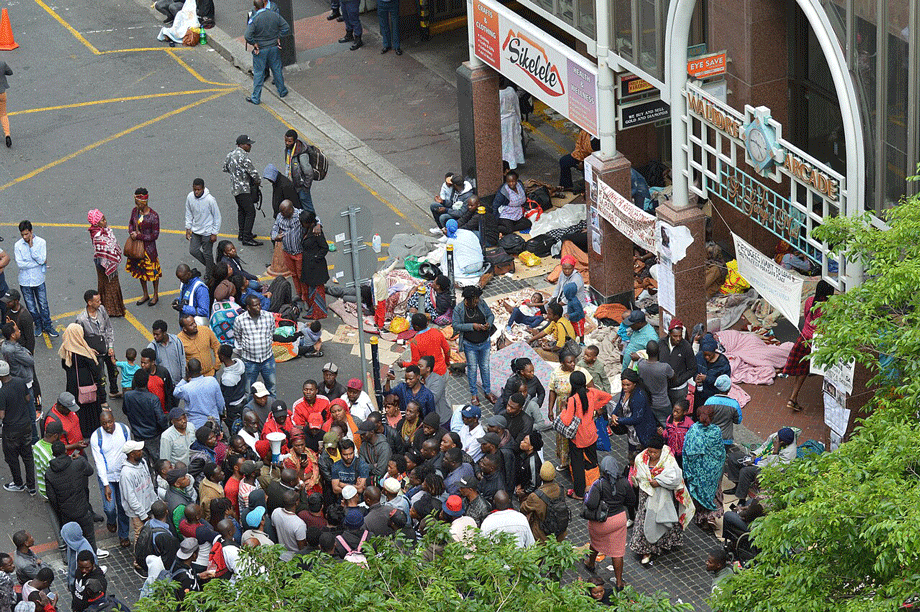
Photo: 14 October 2019 - Foreign nationals staging a sit-in (6 days in by time of photograph) at the Cape Town United Nations Refugee offices to demand that their passage back to their home countries be paid for. The sit-in followed the September xenophobic riots in Johannesburg a month earlier. Credit: Discott, CC BY-SA 4.0, via Wikimedia Commons.
This blog was originally published on LinkedIn, 29 June 2026.
Posted on 30 June 2026, last modified on 20 July 2026