

Let’s collect ‘A Stick in Time’: building a traditional Nzulezo stilt structure

Carlien Donkor is a PhD candidate at the African Studies Centre Leiden. Her project ‘Navigating the Dualities of Inclusive Development within Living Heritage Sites in Sub-Saharan Africa: Nzulezo, Ghana’ researches how the people of the stilted village Nzulezo in Ghana are faced with stagnated development amidst an uncertain future.
Last February, with a team of architectural and media professionals, I made a return visit to Nzulezo for my PhD research and the related EMKP* project ‘A Stick in Time: Documenting Traditional Stilt Construction of the Nzulezo Community, Ghana.’ The focus of the trip was to document, across an array of multi-media, the Indigenous craft of stilt construction unique to this rural community that have lived on and with water for more than five hundred years. It included building a stilt structure for that purpose.
The material was produced with our collaborating builders, community children, and other locals; in some instances we guided contributors on using recording equipment, and informed them their output would be credited accordingly. This experiment in co-creation produced a rich collage of materials, despite the challenges that come with both construction and fieldwork. For the team, it meant a sharp adjustment from urban to rural timing and people relations. We nonetheless completed a typical Nzulezo stilt structure, intended to serve as a living museum of the endangered technique and a learning space for the community's children. Our filming was unscripted, capturing the almost natural rhythm of the work as it unfolded.
Establishing contact, consent and care
After months of planning, we journeyed to Beyin and began with the in-situ formalities: the (re)introduction to Nzulezo Stilt Village Tourism Project (NSVTP) staff, community elders, and the collaborating builders. We were also introduced to the abusuapanyin (family head) of the royal family to seek permission to begin, as custom requires, and to maintain ‘good spirits’ beyond the project’s end. Later I visited the elder of the prototype’s final location at New Nzulezo to make formal presentations.
These interactions revealed the web of local (f)actors at play when outsiders approach Nzulezo, with the NSVTP office acting as the community's formal representatives and as middlemen facilitating ‘access’ to the remote location. The relationship with these gatekeepers - especially my research assistant Frederick Yankey, who also works as a tour guide - was crucial for community sensitisation, acceptance and informed consent, most evident in the morale it gave the building process. Agreements were also made with elders and NSVTP management for the care of the structure after our departure. Some questions I continue to ask: can the local tourism office promote inclusive development for Nzulezo? What are their interests and motivations?
The ‘old’ and the ‘new’: initial impressions
Our first week was programmed for design finalisation, construction estimates and scheduling, material procurement, scouting for interviewees and Indigenous knowledge holders, and getting acquainted with our own team. We made drawings to explain the design, and it was fascinating that the builders insisted on using them to guide construction. Their ability to interpret technical illustrations, combined with the flair of using their eyes to verify alignments and their hands to check structural integrity, raised a point of curiosity about a tradition otherwise passed down verbally and demonstratively.
As a formally trained architect, I found co-designing and co-constructing with the community builders inspiring, especially as we deliberated the floor plans and materiality of a structure meant to showcase the overlay of old and new. The artisans explained why they advised newer materials for longevity and reduced maintenance, and why they preferred certain finishes for an aesthetic appeal widely accepted among residents. I found this ‘newness’ not authentic to their ancestral ingenuity; with some compromise we arrived at a good balance. Newer processes also quickened construction - such as pre-woven roofs from neighbouring Kengen - which we later learned are reserved for those who can afford them, or for cases of urgency.
Filming the foundation in the water
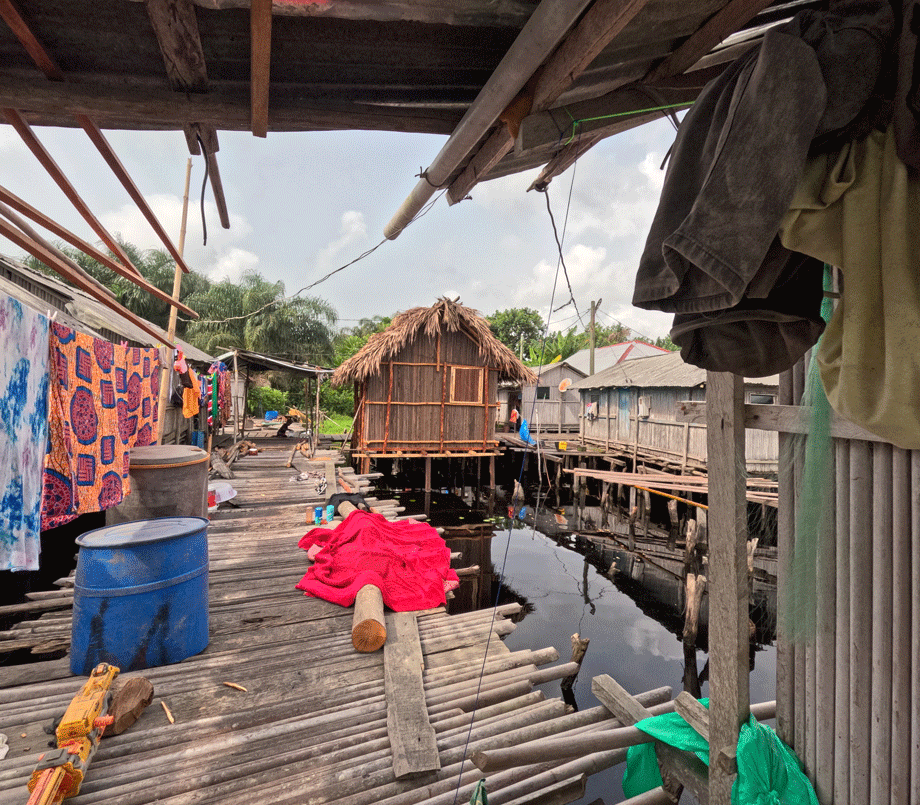
We were struck, too, by our own involvement: loading materials onto a boat, gathering timber and raffia palm ɛya leaves in the swamp forest, our media director diving into the water to film the foundation as the men pounded teak pillars into the river bed. Construction took seven days, slowed by the parallel documentation and by challenges in material availability and precision. Doors were opened to community members and tourists alike, who appreciated the ironically ‘new’ addition so closely resembling the traditional technique - particularly the ɛya roofing, extensively replaced elsewhere with aluminium sheeting (see photo).
The process itself sparked a communal spirit: daily, bystanders were drawn to the site to converse with the builders or lend a hand with the roof. Another observation was the range of economic activities our builders were engaged in - boat drivers in the morning, builders at brunch, bar owners at lunch, fishermen in the late afternoon, guesthouse operators at night. As one builder guided tourists into the pavilion to showcase how traditional roofs are constructed, I could not help but remark that he was indeed the one who built it.
We also filmed social life and the use of spaces, and analysed the rural fabric and building typologies. Some team members spent a night observing evening life and were given a rare performance by community women, who chanted songs from their childhood. A nostalgic mood settled over the village as observers recalled the ‘olden’ days before electricity. In later interviews, some residents described those days as better than today, because life was inexpensive; now they must work harder to sustain a ‘modern’ lifestyle.
The exclusive role of men
Week two moved faster as we grew accustomed to the laissez-faire pace. We filmed seven interviews and held many further conversations to gather intergenerational and trans-gender perspectives, investigating how the community wishes to cope with potential changes to its heritage, the exclusive role of men in this building practice, and its appeal for the younger generation.
Contrary to earlier information about women's involvement in material collection, we found that men undertake this process almost entirely, and women only cook for their partners as they build. We filmed such culinary activity, and still interviewed women about their perspectives on construction and their non-involvement. A brief analysis reveals that the people of Nzulezo encourage change, especially change brought by tourism; that women accept building as a man’s job - ‘it is difficult for a woman to for instance climb a tree to cut wood; also that has been the norm’; and that the youth are more open to jobs in tourism and hospitality. Whether today’s teenagers can build a house as their fathers could at the same age remains to be investigated.
Children visualising a future home
We also ran a group workshop with seventeen children up to twelve years old, asking whether they knew how to build and how they had learnt. Many answered that they helped their fathers. We then asked them to visualise their future home. Their illustrations showed their own impressions of the technique they knew, reflected too in their explanations of where they would live: on water. In another workshop I guided a few girls in building a model of the prototype, while observing the boys making objects from raffia sticks. This prompted me to ponder a gendered division of labour that, in childhood, was clearly neither present nor imbibed: every child was eager to build and invited to assist, whether by passing materials to their father or collecting leftover raffia sticks. Another possible reason for this early inclusivity is that the children needed to entertain themselves - there are few to no recreational facilities beyond swimming, the obvious choice, given their surroundings.
‘Safeguarding without freezing’
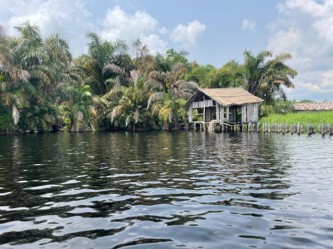
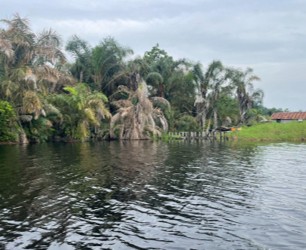
It is impossible for a heritage site like Nzulezo to remain uninfluenced by internal and external choices, decisions and phenomena. Evolution is inevitable - especially where there are opportunities created by a tentative World Heritage status and threats posed by climate vulnerability. In acknowledgement of this, UNESCO developed the concept of ‘Safeguarding without freezing’: guidelines co-formulated with communities and Indigenous people to maintain the viability and transmission of living heritage - skills, rituals, oral traditions - rather than preserving static, museum-like objects. Within two years of my last visit, certain buildings no longer existed, new enterprises had emerged, and some older structures had been renovated or extended. One landmark I missed was the storage shed I had noticed on first approaching the village, now marked only by the ruins of its foundation pillars (see photos: left: the storage structure abandoned during my visit in 2024; and right: its non-existence during my follow-up exercise in 2026).
Nzulezo’s stilt construction appears neither on UNESCO’s List of Intangible Cultural Heritage in Need of Urgent Safeguarding nor on a comparable national register. I admit adding Nzulezo to a heritage register is a complicated stance, since Nzulezo must also be understood as a neighbourhood of private residences where each family may choose what their home looks like. Then again, as in some gated communities, residents can be limited in how much they may alter its appearance.
Similar debates about old-new overlays arose between myself and the builders regarding conservation of the completed prototype. They proposed waterproofing the roof ridge with aluminium sheeting, the part most in need of protection from rain, and lacquering the raffia sticks so they would not fade. We settled on the first; I reminded them that polishing would ‘freeze’ the sticks and fail to reflect their actual exposure to time and weather. I continue to ask whether maintenance here is a matter of convenience - doing as little as possible, because there is no longer the time nor the desire. It also makes me think of urban and Western societies, where industrialisation has deprived inhabitants of the chance to take each day at a relaxed tempo.
Who determines?
I am delighted by the joint effort of skills and backgrounds that shaped this project. We are now making a pre-selection of material, checking whether anything documented is sensitive and inappropriate for Open Access publication for reasons of privacy, culture or other ethical concerns. The language of the project remains Nzema, which speaks to the originality of our primary audience - the people of Nzulezo - but also means accessibility must be broadened through subtitles and English translation throughout. The fieldwork output will be processed into architectural drawings and text.
I must argue that UNESCO's exclusive extension of support to World Heritage Properties and Intangible Cultural Heritage is mirrored at the national level, where former colonial castles and slave dungeons are the primary recipients of governmental attention. And yet there is precedent: the similar stilt settlement of Ganvie, in Benin, lost its tentative World Heritage status - a fate Nzulezo may eventually share. Some concluding questions I leave with readers, and with myself: do tentative World Heritage sites require their own World Heritage in Danger list? And who determines what is in danger, or worth saving?
All photos by Carlien Donkor.
Top photo: One sees other roofs in the community which are now covered with aluminium roofing sheets, while our stilt pavilion stands out as the only structure with ‘ɛya’ roofing material along the main walkway.
Carlien Donkor gave a workshop 'Floating futures: Learning from Ghana' on 26 September 2026 during the Day of Languages and Cultures at the Herta Mohr Building, Leiden. Through creativity and conversation, the workshop explored climate change, adaptation, and the ways diverse cultures and generations envision living with water.
* The doctoral project is funded under the Patrimonies initiative of the Gerda Henkel Foundation and the documentation project is funded under the Endangered Material Knowledge Programme (EMKP).
Posted on 24 September 2026, last modified on 8 October 2026