

Nothing to carry: Moroccan youth, the Ceuta crossings, and the body as a political message
Chaimaa Radouani is an external PhD candidate at the African Studies Centre Leiden, where she researches the migratory ambitions and pathways of sub-Saharan African migrants in Morocco, particularly Nigerian migrants. Her research focuses on the moment when migrants realise that Morocco is no longer just a transit point to Europe, but a place where they choose to settle permanently.
Late July 2026, seventy thousand Moroccans, many of them under eighteen, travelled hundreds of kilometres toward the Spanish exclave of Sebta (the Moroccan name of the exclave Ceuta), after a border was announced as open on social media. Within days almost all of them were back. This blog follows what happened to their bodies before, during and after that crossing, and goes through the interviews they gave. It is the first of two posts on migration from and to Morocco.
Before: nothing to carry
In the last days of July, the train stations in Morocco were crowded in a manner that belonged neither to rush hour nor to a national exam nor to a football match. What the passangers shared was their age; many of them very young, around sixteen or even less, standing on the platforms alone. Ouled Ziane bus station in Casablanca had the same scene the following day. So instead of taking the bus I drove north to my fieldwork site, expecting the ordinary congestion of late July, when families move towards the coastal cities. The motorway was indeed full, but what filled it was unfamiliar. Along both edges, where nothing resembling a pavement exists, people were walking beside a road built for speed. Around Kenitra, roughly three hundred kilometres from Sebta, they were still walking.
In the last days of July, the train stations in Morocco were crowded in a manner that belonged neither to rush hour nor to a national exam nor to a football match. What the passangers shared was their age; many of them very young, around sixteen or even less, standing on the platforms alone. Ouled Ziane bus station in Casablanca had the same scene the following day. So instead of taking the bus I drove north to my fieldwork site, expecting the ordinary congestion of late July, when families move towards the coastal cities. The motorway was indeed full, but what filled it was unfamiliar. Along both edges, where nothing resembling a pavement exists, people were walking beside a road built for speed. Around Kenitra, roughly three hundred kilometres from Sebta, they were still walking.
You might assume that people setting out for a border would carry a rucksack, a small case, or at the very least a bottle of water in that heat, however, there was nothing! They carried what they were wearing, and many had already removed their shirts because of the sun, so that the only thing accompanying them was the wish to leave. When someone walks three hundred kilometres and takes nothing with them, it tells us something about the place they are leaving. What remained was the body itself, the only asset in the calculation and the only thing worth saving.
Why the youth leave
In April 2026, Morocco's High Commission for Planning reported, with the ILO and the European Union, that 2.9 million Moroccans aged fifteen to twenty-nine are neither working nor studying nor in training, a condition statisticians label NEET (not in education, employment, or training), and that this covers one in three young people in the country. Around three quarters hold no qualifying diploma, and youth unemployment stood at 37.7 per cent at the end of 2025. The sociologist Hakima Laala connects those figures to poverty, violence, and exclusion that produces what she calls a loss of hope.
In April 2026, Morocco's High Commission for Planning reported, with the ILO and the European Union, that 2.9 million Moroccans aged fifteen to twenty-nine are neither working nor studying nor in training, a condition statisticians label NEET (not in education, employment, or training), and that this covers one in three young people in the country. Around three quarters hold no qualifying diploma, and youth unemployment stood at 37.7 per cent at the end of 2025. The sociologist Hakima Laala connects those figures to poverty, violence, and exclusion that produces what she calls a loss of hope.
Gen Z movement
It is also critical to remember the autumn of 2025, when the GenZ 212 movement brought young Moroccans onto the streets of a dozen cities, organising on online platform Discord, without leaders or political parties involved, asking for hospitals and schools rather than stadiums. Hundreds were arrested and at least two young men were killed. Ten months later, the same generation, organising on the same decentralised platforms, walked toward a border instead. What matters here is that they had already tried asking to be recognised as humans, and had been answered with force. So those young people do not experience any of this as a statistic; they experience it as a morning with nowhere to be, in a house where a cousin's remittance from Spain pays for what their own presence cannot.
It is also critical to remember the autumn of 2025, when the GenZ 212 movement brought young Moroccans onto the streets of a dozen cities, organising on online platform Discord, without leaders or political parties involved, asking for hospitals and schools rather than stadiums. Hundreds were arrested and at least two young men were killed. Ten months later, the same generation, organising on the same decentralised platforms, walked toward a border instead. What matters here is that they had already tried asking to be recognised as humans, and had been answered with force. So those young people do not experience any of this as a statistic; they experience it as a morning with nowhere to be, in a house where a cousin's remittance from Spain pays for what their own presence cannot.
The announcement & the counting
I learned the reason for all of this the way everyone else did, through Instagram. A border was announced as open on the platforms where sixteen-year-olds spend their evenings, and the choice of platform made the intended audience obvious. The explanations then arrived quickly, locating the event in diplomatic disputes and developments in Spanish law, as though conditions inside Morocco were insufficient reason for a body to want its humanity back. Whatever truth any of those readings holds, each one explains the event through the calculations of governments and leaves out the sixteen-year-old on the motorway entirely. Then came the counting! The totals reached around seventy thousand people converging on the same fence and shore. That is the first thing the border does, since it converts a subject who reasoned their way onto a motorway into a body, and then converts the body into a figure. I want to know what happens to dignity at the end of that sequence, when a person becomes a unit in a headline written in a language they hardly understand.
I learned the reason for all of this the way everyone else did, through Instagram. A border was announced as open on the platforms where sixteen-year-olds spend their evenings, and the choice of platform made the intended audience obvious. The explanations then arrived quickly, locating the event in diplomatic disputes and developments in Spanish law, as though conditions inside Morocco were insufficient reason for a body to want its humanity back. Whatever truth any of those readings holds, each one explains the event through the calculations of governments and leaves out the sixteen-year-old on the motorway entirely. Then came the counting! The totals reached around seventy thousand people converging on the same fence and shore. That is the first thing the border does, since it converts a subject who reasoned their way onto a motorway into a body, and then converts the body into a figure. I want to know what happens to dignity at the end of that sequence, when a person becomes a unit in a headline written in a language they hardly understand.
Crossing of the unwanted body
They arrived in two ways: Some swam around the breakwaters, and others walked in through the Tarajal area after passing checkpoints on the Moroccan side, which is a detail worth holding on to, because a checkpoint is a place where somebody decides whether a body continues or stops. In a survey conducted by NC Report for La Razón, 70.8 per cent of Spaniards described the mass entry into Sebta as an invasion. The vocabulary of invasion describes a body as having no business where it stands, yet, Sebta and Melilla are themselves the continuation of European colonial presence in Africa. Spain has held both cities for more than five centuries without calling that an occupation, whereas a Moroccan teenager who swims a bay for one night becomes an invader within the hour.
‘Engineers and doctors’
Then came the sarcastic comments: ‘The engineers and doctors are on their way’. The mockery was aimed at those who defend migration by insisting that arrivals bring qualifications and contribute economically. Yet both sides of that argument end up accepting the same premise: that a person from the South becomes admissible once they demonstrate profitability. That is a thoroughly capitalist accounting of a human life, and it produces a ranking in which one body is worth admitting and another is worth deterring.
Then came the sarcastic comments: ‘The engineers and doctors are on their way’. The mockery was aimed at those who defend migration by insisting that arrivals bring qualifications and contribute economically. Yet both sides of that argument end up accepting the same premise: that a person from the South becomes admissible once they demonstrate profitability. That is a thoroughly capitalist accounting of a human life, and it produces a ranking in which one body is worth admitting and another is worth deterring.
The body as message
A question was asked on the Moroccan side of the water: what might a body be worth as a message? I have never seen a movement of that scale with no visible convener, which makes the question of who set it moving so hard to avoid. Tens of thousands put themselves on the road within days on the strength of a signal on a screen, and their bodies became the material through which a message was delivered to Madrid, to Brussels, and even to Rabat. Their worth in that exchange had nothing to do with what any of them could do or make, but lay entirely in the fact of their bodies appearing somewhere inconvenient, at a moment when inconvenience was useful. The image that keeps returning to me is the marionette. A marionette is moved without being consulted, performs a scene written elsewhere, and is put away once the scene ends. But it is the wrong image; these young people decided for themselves, walked for themselves, swam for themselves, and several of them said afterwards that they would do it again. Nobody had to persuade them of anything, because the wish had been in place for years and only the opening was new. That wish, to make a family's life better, is exactly what made their movement usable as a message, and it needed no coordination. Their agency was not taken away, it was put to work.
A question was asked on the Moroccan side of the water: what might a body be worth as a message? I have never seen a movement of that scale with no visible convener, which makes the question of who set it moving so hard to avoid. Tens of thousands put themselves on the road within days on the strength of a signal on a screen, and their bodies became the material through which a message was delivered to Madrid, to Brussels, and even to Rabat. Their worth in that exchange had nothing to do with what any of them could do or make, but lay entirely in the fact of their bodies appearing somewhere inconvenient, at a moment when inconvenience was useful. The image that keeps returning to me is the marionette. A marionette is moved without being consulted, performs a scene written elsewhere, and is put away once the scene ends. But it is the wrong image; these young people decided for themselves, walked for themselves, swam for themselves, and several of them said afterwards that they would do it again. Nobody had to persuade them of anything, because the wish had been in place for years and only the opening was new. That wish, to make a family's life better, is exactly what made their movement usable as a message, and it needed no coordination. Their agency was not taken away, it was put to work.
Those who crossed understood this quickly. One of the questions they asked journalists on the Moroccan side, while buses waited to carry them home, was: ‘I want to know why they opened it if they were planning to bring us back’. The people who gave the signal are the only ones in possession of a reply, and they have offered none.
Return: the invisible chain
Watch the videos of the entry into Sebta and you see victory signs and shouts of ‘Viva España’ from young people who had come out of the water minutes earlier. Watch the return and you see grief and anger. Yet many had lost none of their resolve and told journalists they would try again. Something takes hold of the body at that border, and it does not loosen once the body has been pushed back. I think of it as an invisible chain, pulled from the Moroccan side or the Spanish/European side depending on which stands to gain. The chain has no interest in where the body wants to go, since it moves the body to wherever the body is useful.
Watch the videos of the entry into Sebta and you see victory signs and shouts of ‘Viva España’ from young people who had come out of the water minutes earlier. Watch the return and you see grief and anger. Yet many had lost none of their resolve and told journalists they would try again. Something takes hold of the body at that border, and it does not loosen once the body has been pushed back. I think of it as an invisible chain, pulled from the Moroccan side or the Spanish/European side depending on which stands to gain. The chain has no interest in where the body wants to go, since it moves the body to wherever the body is useful.
What is left unsaid
The interviews are worth going through twice, once for what is said and once for what is left unsaid. Those who returned spoke about poverty, unemployment, schooling that led nowhere, the humiliation of having nothing to do, and the state of waithood they live in. When the conversation reached the border, the grammar changed, because the question became why they opened it for us and then brought us back, with the pronoun ‘they’ left unattached to anybody in particular. Nobody was named, the agent that opened the coast and closed it again stayed in the passive voice.
The interviews are worth going through twice, once for what is said and once for what is left unsaid. Those who returned spoke about poverty, unemployment, schooling that led nowhere, the humiliation of having nothing to do, and the state of waithood they live in. When the conversation reached the border, the grammar changed, because the question became why they opened it for us and then brought us back, with the pronoun ‘they’ left unattached to anybody in particular. Nobody was named, the agent that opened the coast and closed it again stayed in the passive voice.
That silence is the most articulate thing in the archive; it shows a subject who knows exactly where the limits of speech run and has calculated what it costs to cross them, so that the same person willing to swim at night toward a fence was unwilling to finish a sentence in front of a camera. Power gains twice: it gets the use of the body and the discretion of the subject in one transaction. The body speaks loudly enough to reach Brussels, while the subject says nothing that could be quoted back to Rabat. The departure of seventy thousand people itself was the message to Rabat, and it needed no words, which is perhaps why none were offered.
I am aware of my own positionality here, because I can describe the motorway rather than walk along it, although the people on that road came from the streets and schools I grew up in. I grew up inside the vocabulary they were using. Lhrig, the burning of papers. Brra, the outside. Lghorba, which names a strangeness beginning long before anyone departs. The word closest to what the body was after in July, however, is lharba, escape, which the Moroccan journalist Taoufik Bouachrine has called the great escape. And truly, It was an escape in every sense the word can carry.
These words enter a child's ear early and stay there. The harder question, then, is not why a sixteen-year-old believed what he read on TikTok and started walking north. It is what kind of country persuades a teenager of sixteen that their life is finished because they have achieved nothing yet. The Moroccan sociologist and historian Mohammed Ennaji put the question starkly: ‘Apprendre à lire ou apprendre à nager pour survivre? Là est la question!’ (‘Should we be teaching them to read, or teaching them to swim in order to survive, that is the question.’) Bouachrine's answer is that at this point we had better teach them both.
A mother waiting for her son
At least one hundred people paid for the announcement with their lives. They will be counted once, folded into a total, and cited in future reports as evidence of a pressure requiring management. On the far shore a mother was waiting for a son who never came out of the water, and in some neighbourhood of Tetouan or Fes a child is still waiting for a parent who left carrying nothing except the wish to send money home… Those are the units in the arithmetic.
At least one hundred people paid for the announcement with their lives. They will be counted once, folded into a total, and cited in future reports as evidence of a pressure requiring management. On the far shore a mother was waiting for a son who never came out of the water, and in some neighbourhood of Tetouan or Fes a child is still waiting for a parent who left carrying nothing except the wish to send money home… Those are the units in the arithmetic.
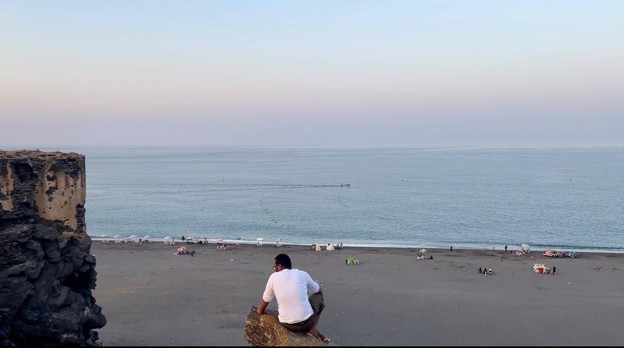 I keep an evening photograph taken in Morocco two summers before any of this, a young man sitting on the rocks with the sun going down in front of him. He is doing what anyone does when staying is an option, which is to look at water and think about very little, because the sea in front of him is only the sea. For the sixteen-year-old on the motorway it was never scenery. He had worked out that it was the only road open to him, that it ran in one direction, and that his own body was the fare.
There is one more thing in that frame: the city behind him. The fieldwork I was driving toward that week, is with highly skilled Nigerians who came to Morocco meaning to pass through, but instead decided to build lives in Moroccan cities, in the very places a sixteen-year-old had concluded they held nothing for him at all. Two verdicts in the same country, delivered in the same month. What separates them is not the place. It is what each of them was permitted to be while standing in it. And this will be the subject of my next blog.
A note on sources: The observations about what those who crossed said, and avoided saying, come from interviews broadcast and published by Moroccan media outlets in late July and early August 2026, namely: Hespress, alalam24, LalaMoulati, achamal24, Madar21, The Voice (Sawt AlMaghrib)
Photos by Chaimaa Radouani.
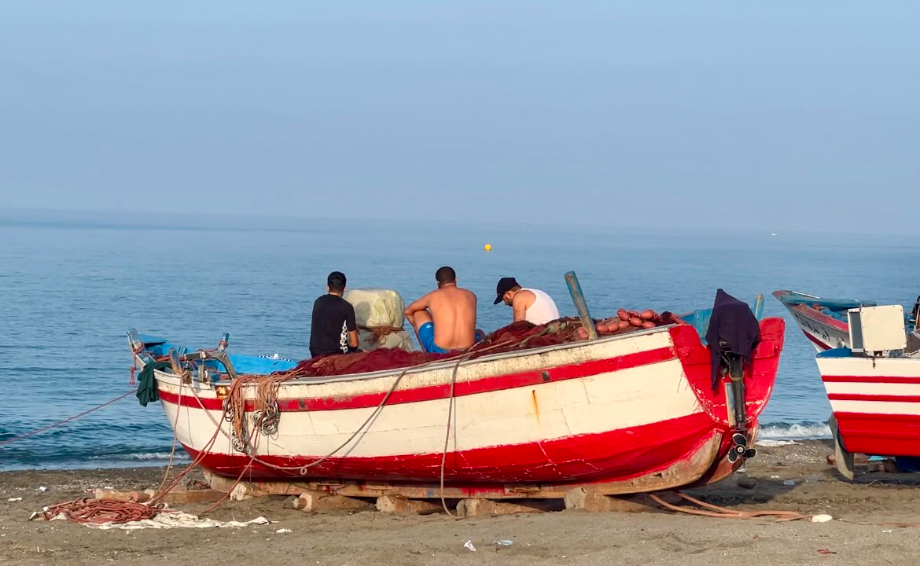
Top photo: Men sitting on a boat, northern Morocco, August 2024.
Lower photo: A young man watching the sea above a summer beach, northern Morocco, August 2024.
Top photo: Men sitting on a boat, northern Morocco, August 2024.
Lower photo: A young man watching the sea above a summer beach, northern Morocco, August 2024.
Posted on 14 August 2026, last modified on 17 August 2026