

The Sundiata epic: for teaching, studying and experiencing
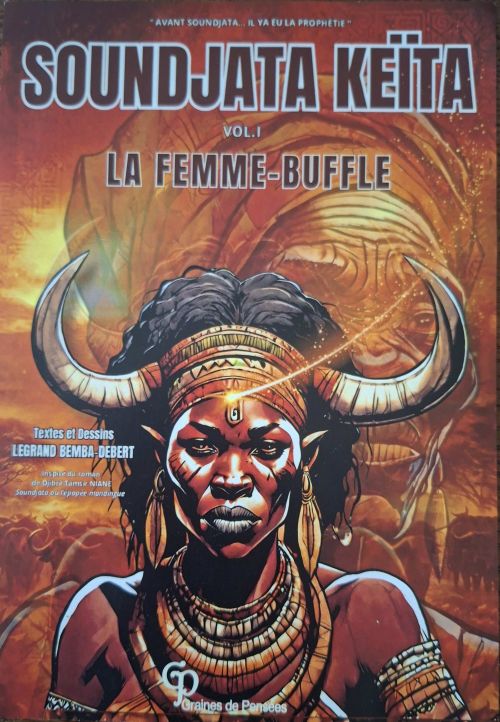 Two recent additions to our library, Teaching World Epics and Soundjata Keïta, Vol. 1, La femme-buffle, provide an opportunity to take a closer look at the Sundiata epic, which tells the story of the founder of the Mali Empire in the early 13th century.
Teaching world epics
Teaching World Epics is a collective work in which various specialists discuss epics from around the world from the perspective of how to teach them. Homer’s Iliad is included, as are the 14th-century Ethiopian Kebra Nagast (The Glory of the Kings) and the Mwindo epic of the Nyanga in the DRC. John William Johnson contributed the chapter on the Sundiata (Sunjata, Soundiata, Soundjata) epic: the famous Mandinka narrative poem, which is still passed down to this day through oral tradition, about Sundiata Keïta, the founder of the illustrious medieval Mali Empire.
The Sundiata epic
Sundiata’s worldwide fame began in 1960 with the publication of Soundjata ou l’épopée mandingue by the Guinean historian and writer Djibril Tamsir Niane, who based his translation on an oral rendition by the Guinean griot (traditional bard or jele) Mamadou Kouyaté. In 1965, Niane’s book appeared in English translation: Sundiata: an epic of old Mali. Since then, interest in the Sundiata epic has flourished. Versions by other griots have been recorded, transcribed, translated and studied from a variety of perspectives. In 1997, A checklist of published versions of the Sunjata epic already contained 64 entries. Recordings can now be found on YouTube (and also here), and episodes have been adapted into all manner of forms: verse or prose, for children, in comic strips, in films, on television and in theatre.
This year, the Togolese publisher Graines de Pensées released the graphic novel Soundjata Keïta, La femme-buffle, the first instalment of what is set to become a trilogy. Both the text and the illustrations – often full-page in size – are by Legrand Bemba-Debert, who drew inspiration from Niane’s book.
Students exploring their origins
Four friends studying at the Sorbonne - two of whom have just arrived from Mali and two of whom were born in France - are set a task by their professor to explore their pasts. Malick and Manfila from Mali, one a descendant of Sundiata Keita, the other a descendant of his arch-enemy Soumaoro Kanté, are visited in their sleep by spirits who want to set them against one another.
But there is more going on at night: in the corridor of their dormitory, the four friends discover a secret gateway that transports them to a small village where an old man is waiting for them and begins to tell the story of Sundiata: how Sundiata’s birth was foretold to his father, the Mandinka king Maghan Kon Fatta, and how the ‘buffalo woman’, aunt of Sundiata’s future mother, reveals to two hunters the secret of how they can kill her whilst she is a dangerous buffalo – her double. Only in this way can the prophecy be fulfilled that her niece will marry the king and become Sundiata’s mother. In the words of the old man, as in Niane’s version: “Oh king, for destiny to lead this woman to you, a sacrifice is necessary; you must offer up a red bull, for the bull is powerful. When its blood soaks into the ground, nothing more will hinder the arrival of your wife.”
At night, the students pass through the gate, and by day they throw themselves into the study of the Sundiata epic. Brianna and Élijah, too, are now visited in their dreams by the spirits of their ancestors. Their professor will have the task of steering all this in the right direction, but that is for the next instalments…
Johnson emphasises the importance of studying the Sundiata epic from a translation of an authentic text as recited by a griot. However, Bemba-Debert’s adaptation, too, provides interesting angles from which to look into the epic and its social function. The students’ ancestors appearing to them in their dreams ties in with a function of oral performances mentioned by Johnson: the enabling of audiences to connect with their families’ place in Mandinka history and with the great hero Sundiata himself (p. 260).
Silence as a space for creation
Bemba-Debert lends his graphic novel a special dimension by revealing to the reader that one event changed everything for him: he lost his hearing. As a result, imagery came to occupy a central place. Glances, gestures and settings came to speak louder than the text, and out of the silence emerged a visual story which he hopes the reader will be able to experience in much the same way as when watching a series. Silence became a place of creation. And, as he writes, not everything is explained.
This makes it all the more inviting to follow the example of the students at the Sorbonne and, alongside this graphic novel, search the library for texts, analyses and background information on the epic of Sundiata.
Materials on the Sundiata epic, both in the African Library and the Leiden University Library collections can be found via Sunjata (or by typing Sunjata in the All content search field of the catalogue). From there, you can refine your search by filtering by resource type, creation date, language, etc. and/or by combining these with an author’s name or content term.
Heleen Smits
Posted on 31 August 2026, last modified on 8 September 2026