

Acquisition trip to Benin October 2025
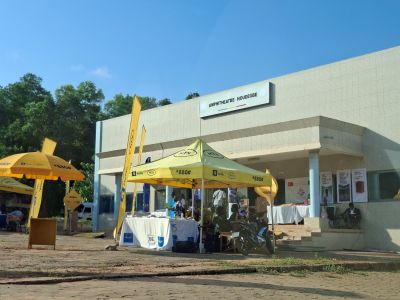 From 9 to 19 October, Heleen Smits visited Benin to buy books for the African Library. After a fascinating trip, she set off for home with more than 250 books.
Large posters advertising the Fête du Vodoun in the southern Beninese city of Ouida on 10 January 2026 flank the route to passport control at Cotonou airport. From 9 to 19 October, I will be in Benin to buy books for the African Library. Vodun is an officially recognised religion in Benin, just like Christianity and Islam, and it plays a significant role in the lives of many Beninese people. Two Christian booksellers I talk to are not very happy about this: they believe that Christianity (or Islam) and Vodun practices are incompatible, but many combine them. Christian books I purchase at various locations offer advice on issues such as relationships, sexuality, childlessness, work, and saving money, but also on how to ward off witchcraft.
Bookfestival on the campus of the University of Abomey-Calavi
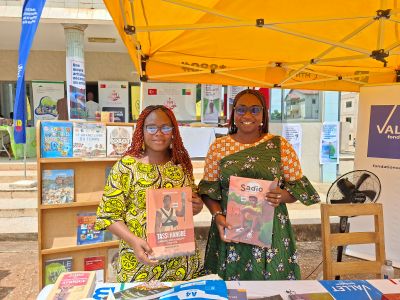
At the Festival International du Livre et des Arts Assimilés du Bénin (FILAB), which takes place from 7 to 9 October on the campus of the University of Abomey-Calavi, different beliefs and faiths are represented. There is a stall run by Presses Bibliques Africaines, but also, for example, by a Turkish Muslim organisation, and an individual author is selling his own work on Vodun. The Zinsou Foundation is also present at the festival, an organisation that has been in existence for 20 years and, with a museum and exhibitions in Ouida and Cotonou, is committed to making Beninese and African artistic creation and cultural heritage accessible to as wide an audience as possible. In addition, the Fondation Zinsou publishes catalogues and other books on art, culture and society, some of which are open access available online. Topics range from Vodun, wax prints, and African hairstyles to representations of rulers and warriors of the Dahomey (Danhɔmɛ, Danxomè, Danhomè, Abomey) Kingdom that existed from ca. 1600-1900. The pictorial work with black-and-white photographs of the Cotonou-Parakou railway line that I purchase is beautifully published: the pages are not cut open on the long side and the photographs run from the odd to the even pages. No books are for sale at the Fondation Vallet stall, but a selection from one of the nine libraries financed by this organisation in Benin is on display.
Motorcycle taxi’s
 This is my first time in Benin and, after passing the friendly customs officers at the airport, I am now on my way by taxi to my accommodation in Zogbadjè, near the university campus. I am amazed by the enormous number of motorcycles. Many drivers wear yellow vests: these are the zémidjans or zems: the motorcycle taxis. In some parts of the city, there are separate lanes for the motorcycles, which are packed when we drive past them. In book illustrations, the zems and other motorcycles contribute to the couleur locale, but the taxi driver grumbles that the French have made the roads too narrow, so that the city's residents have no choice but to use the motorbike.
Amazons and other hero(in)es
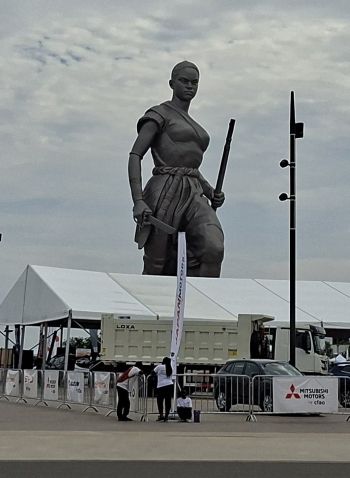
I spend the second part of my trip in Cotonou. Drivers take me to bookshops in the city by zem (with a helmet and hairnet provided by the driver), tricycle or car taxi. As we drive along the southernmost wide road parallel to the coastline, the gigantic Amazon monument rises up on the side. The statue of a female warrior from the Dahomey Kingdom is 30 metres high and was designed in China. Unveiled in 2022, it pays tribute to the legendary Amazons (Agoodjié or minons): an elite corps of highly trained women, famous for their fearlessness in combat, which existed from the early 18th century to the end of the 19th century. The image of the Am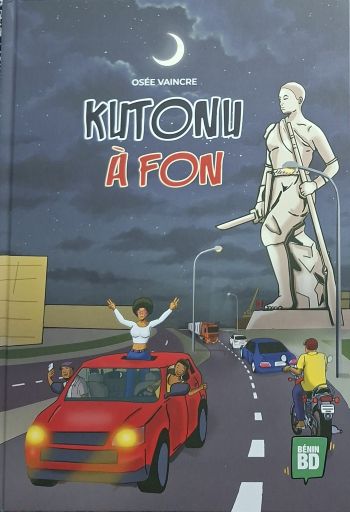 azon statue appears on the cover of a comic strip and a children's book that I bought. Another comic strip, Dahomazone: première mission, has transported the Amazons to the present day, where they fight against extraterrestrial beings.
Various rulers of the Dahomey Kingdom continue to inspire Beninese authors and illustrators to create (heroic) stories in comic strips or other forms. Examples include Tassi Hangbè (Tasi Hangbè, Nan Hangbe), the only female ruler of the Dahomey Kingdom, who was in power for a short period in the early 18th century and Béhanzin (Gbɛ̀hanzin, Gbéhanzin), who resisted the French colonisers but was defeated in 1894.
Cotonou bookshops
Cotonou has a number of excellent bookshops and I naturally bought all kinds of other books too, such as on concrete made from palm nut shells, gender-related violence, democracy, African students in Russia in the 1960s, the Constitution (including a translation of the Constitution in the Baatɔnum language), edible mushrooms, the Methodist Church, schoolbooks for English, geography and history, multilingual education, etc. Also telephone directories of 2003 and 2005-2006, the latter thinner than the forme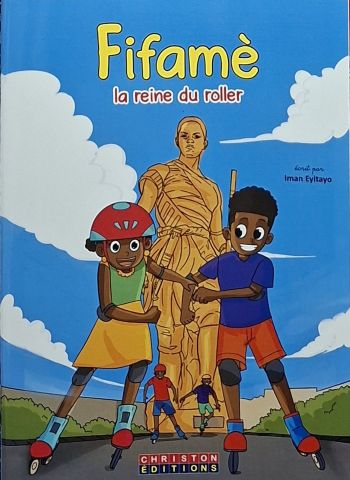 r, and a Yellow Pages of French-speaking African countries.
I have booked extra baggage allowance for the flight home, but in the end I still have too much. After repacking my bags three times at the airport and wrapping a limp rucksack full of books in duct tape, I pay a reasonable excess baggage fee, give a patient airport employee a book as a thank you, and set off for home with more than 250 titles.
Search tips
Here are some search terms that can help you find the books described above. You can paste them in the Leiden collections – African Studies Centre part of the UBL catalogue (or just click on them). Note that compound terms such as Dahomey polity are held together as one string by the apostrophs. The operator AND combines two different terms. Please note that it will take some time before all books are catalogued.
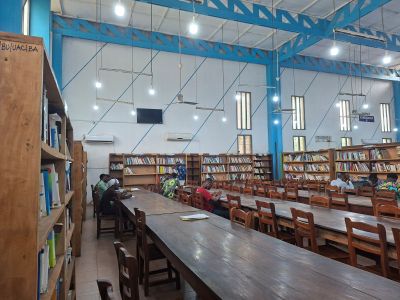
In the atmospheric university library on the campus of the University of Abomey-Calavi, long wooden tables seat nearly 400 students; around them are books in wooden cabinets along the wall. When I visit, there is plenty of space because it is holiday time, but at other times of the year there is not enough room for everyone who wants to study here. Purchasing books is difficult for the library because they are expensive. A collection of Japanese and Chinese books have been donated by the respective embassies. |
But please don't hesitate to ask if you could use some help!
Vodun AND Benin
“Dahomey polity”
“comic strips (form)” AND Benin
“Fondation Zinsou”
Heleen Smits
Posted on 9 December 2025, last modified on 30 March 2026