

Desmond Morris (1928-2026), a personal memory by Wouter van Beek
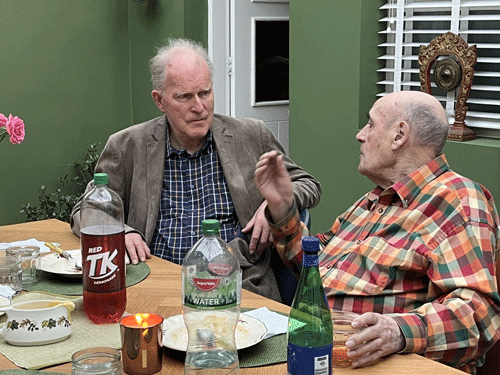
On 19 April, zoologist, writer, painter and broadcaster Desmond Morris passed away. Morris invited Professor Emeritus Wouter van Beek to his home in Ireland in April 2024 to discuss African bronzes, Dogon art, Dogon people, brass casting, and Africa more broadly. Van Beek recollects.
At his home in Ireland Desmond Morris quietly passed away on 19 April, joining what he himself called ‘the Great Recycling Plan of Nature’ at the ‘ridiculous age’ – his own words – of no less than 98 years. Over the course of his long and immensely productive life, our paths crossed on two occasions. The first time was in a very indirect way in 1994, when I hosted the BBC film crew in my Dogon home as they were producing ‘The Human Animal’, one of his many television productions. He could not come to Mali himself, but his team taught me to look at people through a completely different lens, Desmond’s lens: man as an exalted ape. It was a revelation.
It took us thirty years to truly meet, in April 2024. An e-mail appeared in my inbox, signed DMorris, asking me questions about ‘African bronzes’, and it was indeed the Desmond of The Naked Ape and The Human Animal – as well as many other books and films – and he was still alive! I was working on a book about Dogon art, and since he seemed to have a considerable collection of African art – gathered on his many travels – he invited me to his home. Realising he was 96 at the time, my wife and I immediately booked a flight to Dublin, rented a car, and the following week we showed up at his door. He welcomed us like long-lost family members, marking the beginning of an unforgettable evening. From 5 to 11 p.m., we talked non-stop about his book, the Dogon people, brass casting, and Africa more broadly. He had a superb collection of African art, which I was free to use as I saw fit; we exchanged books, and he discovered that I had in fact worked for him back in 1994. Ebullient, enthusiast and brimming with energy, he led me through his large collection, reminiscing about travels, films and books, while listening attentively to what I had to tell. During our six-hour conversation, barely interrupted during dinner at his son’s house right next door, he even sometimes forgot that he had to use a walker; it was one of those encounters that make up the highlights of a lifetime.
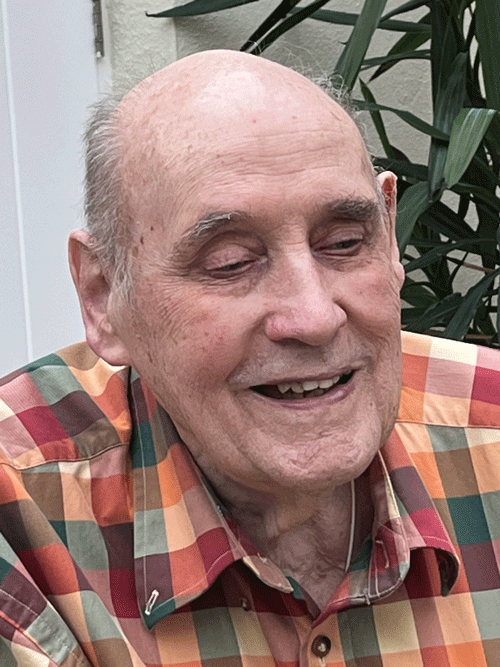 Back home, we continued to exchange e-mails about his new books, his family, and my books, but I assured him I couldn’t keep up with him, since the number of his books almost equals his age. Many of his recent works deal with painting, as he considered himself first and foremost a painter, one of the last surviving Surrealists. His last project was to collect Sentani bark paintings from New Guinea – very surreal! – and it is a shame that this book will never see the light of day. But we have so many memories of him, of a life lived to the fullest, a lasting inspiration also for those whose lives just crossed his long pathway through this world.
Credit photos: Martina Bom.
Posted on 23 April 2026, last modified on 20 August 2026