

Breaking the cycle of mutually reinforcing societal stressors and mental health problems in Burundi
 Burundi, troubled by a long history of violent conflict, risks to remain ‘trapped’ in conflict cycles. Research has well established that alongside other ‘conflict risk factors’ such as poverty, a youthful population and non-democratic governing system, the experience of violent conflict has significant impact on potential repetition of conflict. In recent years, particularly the psychosocial consequences of war have been recognized as adding a destructive dimension to the post-war environment. Burundi’s violent past haunts the present not only through the material and social devastation it has left next generations with, but also through the large mental health burden, which in turn risks to contribute to conflict relapse.
This proposed research and research capacity building project, seeks to contribute to building knowledge on mental health problems and care in Burundi through a multilevel approach, involving various mental health care actors in clinical and community care and scientific knowledge. The project is designed to strengthen research capacity in the process of generating new research and knowledge. The research investigates how societal stressors - conflict and conflict-related – and mental health problems may mutually reinforce each other in Burundi. The aim is to identify how policy and intervention in and on care can start breaking these negative cycles and contribute to a peaceful and prosperous Burundi.
The research takes a multilevel approach to investigate the entanglements of societal stressors and mental health, with studies focusing on the individual, familial, communal and institutional level. The overarching question of the research is: In what ways can mental health care policy and interventions help break the cycle of mutually reinforcing societal stressors and mental health problems in Burundi?
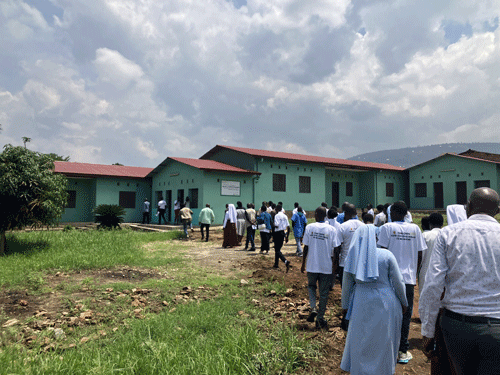
Photo: Festive opening of a new department of the Kamenge neuropsychiatric hospital in Bujumbura, Burundi. Credit: Lidewyde H. Berckmoes
Research project
Period:
2026 to 2029
Status:
Ongoing
Senior researchers
Geographic
Keywords
Cyclical conflict, societal stressors, mental health problems, care, research capacity
Funding and cooperation
Funding:
The project is funded by the Swiss Confederation as part of the programme 'Santé Mentale pour la Paix et le Développement Durable au Burundi 'NI ABACU'.
Cooperation:
The project entails a collaboration between the African Studies Centre Leiden (ASCL) of Leiden University and the University of Burundi (UB), the Centre Neuro-psychiatrique de Kamenge (CNPK), and Trauma Healing and Reconciliation Services (THARS).