

African agency on the shopfloor: What hidden worker resistance reveals about Africa-China engagement

Robel Mulat is an Assistant Professor at Dilla University, Ethiopia. He was a visiting fellow at the African Studies Centre Leiden earlier in 2026. As an urban anthropologist, his research examines the intersection of urbanisation, industrialisation, and migration. Robel’s recent work examines how multipolar power dynamics, particularly among China, the United States, and Ethiopian state actors, are experienced and reinterpreted by local Special Economic Zone workers.

Chong Zhang is a PhD candidate both at the African Studies Centre Leiden and the Institute of Economic Sociology and Multinationals (IESM, Shanghai University). He conducts research on Chinese investments in African countries including Ghana, Ethiopia and Egypt, especially in the sectors of agriculture and infrastructure, with a particular focus on the daily interaction from both Chinese and African sides to understand the economic, social and cultural outcomes.
Africa-China relations are made not only in ministries and diplomatic meetings. They are also made through everyday encounters in the workplace, between supervisors and workers. Research by Robel Mulat and Chong Zhang in Ethiopia and Ghana suggests that resistance does not always take the form of strikes, demonstrations, or open confrontation; workers also resist through everyday actions that are easy to overlook. Moreover, a comparison between the two countries challenges the idea that Chinese engagement produces a single or uniform labour experience across Africa.
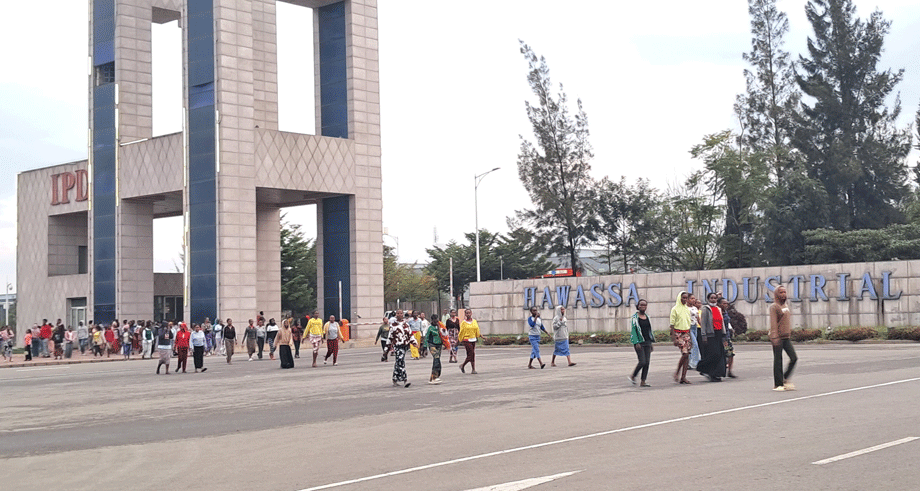
On a busy morning in July 2025, Seble Ketema*, a young Ethiopian woman working in a Chinese textile factory in Hawassa Special Economic Zone (HSEZ), needed time away from work. She went to her line supervisor and asked for leave, explaining that a close relative had died in accident. The relative had not actually died. From her previous experience, Seble knew that she needed a serious reason for her request to be accepted. As she explained, managers often treat workers as if ‘we are robots.’ They expected them to keep working without recognising that they were human beings who needed breaks and time to attend to their social responsibilities.
These small acts are not unusual. Workers sometimes take unexpected breaks, stay away from the production line, slow their pace, or find reasons to leave when work becomes difficult. Some stay longer than necessary in the toilet or at the water point, using these spaces to rest before returning to work.
Coordinating positions in WhatsApp groups
Similar things happen thousands of kilometres away. At a Chinese-operated power plant in Ghana, workers use informal WhatsApp groups to discuss management decisions before responding to them at work. Technicians and subcontracted workers compare information, discuss how to respond to new demands, and coordinate their positions before speaking to supervisors. One day, for instance, the operation manager announced that workers from different shifts would be reshuffled. The sudden change threatened the informal arrangements workers relied on, including swapping shifts so that Christian workers could attend Sunday church services after demanding night shifts. Workers shared the notice in their WhatsApp groups, expressed their frustration, and agreed to respond collectively. When supervisors approached them, they explained that the new shifts would make it difficult to manage religious commitments. Faced with their united response, management eventually put the reshuffle on hold.
Resisting without protesting
These were not unique acts of protest. But they raise an important question that is often ignored in discussions of Africa-China relations: What happens when workers resist without protesting? Our research in Ethiopia and Ghana suggests that resistance does not always take the form of strikes, demonstrations, or open confrontation. Workers also resist through everyday actions that are easy to overlook.
In HSEZ, workers describe and demonstrate a range of quiet ways to respond to managerial pressure. Some workers pretend not to understand instructions, especially when they disagree with what was being demanded of them. One worker recalled being confronted by a Chinese manager over a speed problem. The manager shouted at her while a translator explained the complaint in Amharic, the lingua franca of the workplace. Although she understood Amharic, she pretended not to understand and told them that she spoke only local language. By doing so, she delayed responding to the manager without openly confronting him.
These small acts allow workers to cope with managerial pressure while quietly questioning the authority of those who supervise them. For many workers, directly confronting a supervisor can be risky. Many have migrated from rural areas to HSEZ with high expectations such as better and modern urban life. Instead, they often encountered low wages, demanding production targets, and unhealthy working conditions. A worker explained that they feared dismissal. Losing a job could mean losing an important source of income for themselves and their families. Quiet resistance therefore offers another possibility, workers can challenge particular demands without necessarily turning the disagreement into an open conflict.
This does not mean that workers are always successful. Nor do all workers see the same actions as legitimate. In HSEZ, for example, disagreements emerged around cloth thefts that some workers attributed to male colleagues. Some viewed such acts as a response to exploitation, while others condemned them as unethical and damaging to workers’ collective interests. These disagreements sometimes weaken solidarity and encourage workers to choose other forms of resistance. Resistance, then, is not a single collective strategy. Workers constantly assess what they can do, what may be risky, and what may work.
Different workplaces, different repertoires
Since 2021, Robel has been conducting ethnographic fieldwork in HSEZ, Africa’s largest Special Economic Zone, designed to create around 60,000 jobs. Meanwhile, between 2020-23, Chong conducted fieldwork at a Chinese-operated power plant in Ghana and expanded the research through additional fieldwork in Rwanda, Ethiopia, and Egypt. Ethiopia and Ghana representing East and West Africa, have become key destinations for Chinese foreign direct investment. However, there are differences between the two countries in terms of labour market structures and their determinants. Much of what we observed was not highly visible. Instead, workers resisted in quieter ways. These practices rarely attract public attention, yet they influence workplace relations and the implementation of infrastructure projects.
The Ghanaian case shows another version of this process. Take for example the earlier mentioned Chinese-operated power plant. Here, workers did not simply accept management decisions, yet neither did they always challenge them openly. Ghanaian technicians and subcontracted workers developed WhatsApp groups that operated largely outside management’s view. These groups were primarily organised along departmental lines, particularly among the Ghanaian technicians across the five operational shift teams and maintenance units. They grew out of the everyday realities of plant life, as local workers relied on one another to cope with exhausting shifts, wage inequalities, and language barriers with Chinese supervisors.
This became particularly important when management introduced stricter performance expectations. Instead of openly refusing, workers sometimes followed safety procedures to the letter. The result could be slower operations. Workers could defend their actions as compliance with safety requirements while also using the rules to place limits on managerial demands. This form of resistance is sometimes called ‘malicious compliance’: workers follow an instruction so strictly that it produces an outcome management did not expect.
Labour Unions
Ghanaian workers could also draw on more formal institutions. Skilled workers used their connections with local labour unions to threaten formal grievances when workplace disagreements escalated. In this way, informal and formal forms of resistance could work together. A worker might first discuss a problem privately with colleagues, coordinate a response through an informal network, and then use union channels if necessary. The result was a hybrid form of resistance: quiet negotiation on the shop floor combined with the possibility of formal collective action.
Historical contexts
The differences between Ethiopia and Ghana are not simply differences between two groups of workers. They reflect the histories and institutions in which workers have learned to navigate employment, authority, and insecurity. Many workers in Ethiopia’s Special Economic Zones are young and rural migrants. In many companies, female operators are deployed to perform what are considered to be low-skilled tasks, such as sewing, recording, and quality inspection. Factory employment can therefore represent both an opportunity and a new form of discipline. Workers enter the factory with previous experiences of work, mobility, and negotiating difficult economic circumstances. When formal channels for challenging workplace decisions are limited, they may rely more heavily on personal networks and temporary withdrawal.
Formal workplace resistance is also difficult because of the unequal balance of power between workers, investors, and the state. Workers have limited bargaining power, while investors and government authorities hold greater influence over employment conditions and industrial policy. Some workers complained that government institutions were more concerned with protecting investors and maintaining a favourable investment environment than with addressing workers’ grievances. In this context, openly challenging management can be costly for workers, particularly when they believe that formal grievance mechanisms offer little protection or that employers can easily replace them. As a result, many workers rely on quieter forms of resistance that allow them to express dissatisfaction while minimising the risk of losing their jobs.
Ghana
The Ghanaian context provides a different set of possibilities. Workers at the power plant could draw on occupational expertise, informal networks, and labour organisation. Ghana has an established tradition of formal unionism anchored by the Trades Union Congress (TUC) and sectorial bodies like the Ghana Mineworkers’ Union (GMWU), supported by statutory protections under the Labour Act and the 1992 Constitution. Ghanaian technicians and engineers have a strong sense of professional dignity and a tradition of independent trade unionism. When conflicts arise, they draw on this experience and institutional knowledge to organise, negotiate, and seek support from national labour bodies. Yet the existence of these institutions did not eliminate hidden resistance. Workers continued to use informal communication, humor, strategic compliance, and other quiet tactics.
This comparison matters because workers do not enter Chinese-managed workplaces as blank subjects. They bring histories of employment, relationships with authority, social networks, and expectations about what can be negotiated. These experiences shape the forms of resistance available to them.
‘Weapons of the weak’
The sociologist James Scott (1985) described such practices as the ‘weapons of the weak’, forms of everyday resistance that emerge when direct confrontation is costly or unlikely to succeed. His insight is useful for understanding why workers may resist without openly confronting those who have greater power.
Our research builds on this idea but also shows why everyday resistance needs to be understood in its local context. A worker who stays away from a production line, a group that communicates through WhatsApp before responding to management, or technicians who insist on following safety procedures may appear to be acting individually. But these actions are connected to wider social relationships, workplace cultures, and institutional environments. While Ethiopian workers often relied on individual withdrawal because formal channels were weak, Ghanaian workers could combine informal tactics with union support.
African agency on the shopfloor
They also challenge a common image of African workers as passive recipients of foreign investment. Chinese industrial projects are often discussed through the decisions of governments, investors, and companies. Yet the projects only function because workers make thousands of decisions every day: whether to follow an instruction immediately, whether to negotiate, whether to slow down, whether to speak to colleagues, whether to leave, or whether to comply in a way that changes the outcome. This is where African agency becomes visible, not only in government negotiations with China or in formal labour organisations, but also on the shop floor.
The comparison between Ethiopia and Ghana challenges the idea that Chinese engagement produces a single or uniform labour experience across Africa. The companies and projects may be Chinese-managed, but workers interpret and respond to them through locally grounded practices. The same managerial pressure can produce different responses depending on workers’ employment histories, social networks, gender and occupational position, as well as the political and institutional environment around them.
Africa-China relations: multipolarity from below
In this sense, Africa-China relations are made not only in ministries and diplomatic meetings. They are also made through everyday encounters between supervisors and workers. These encounters reveal a form of multipolarity from below. Global power relations are not experienced only through states and corporations. They are also negotiated by workers who cooperate, negotiate, and quietly resist within the workplaces where global projects are built.
To understand Africa-China engagement, therefore, we need to look beyond the agreements that bring Chinese capital and infrastructure to Africa. We also need to look at the workers who encounter these projects every day, and in the small, sometimes almost invisible ways they negotiate the terms of their participation.
* In this blog, pseudonym names were used to protect the identity of research participants.
Photo credit:
Photo taken in Hawassa Special Economic Zone by Robel Mulat.
Posted on 28 September 2026, last modified on 29 September 2026