

Double Seminar of the CRG Conflict continuities:Preventing violent extremism in Kenya: the presence and absence of African women
Primary tabs
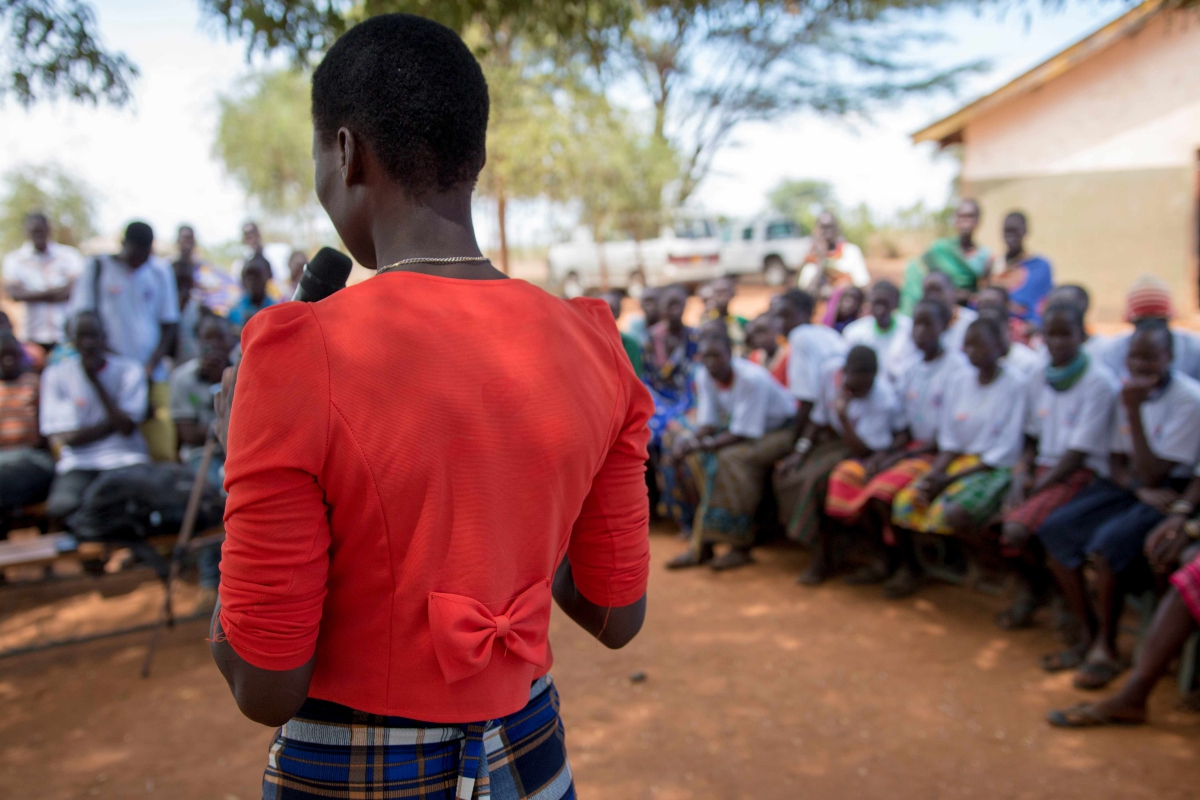
In this public hybrid seminar, organised by the Collaborative research group ‘Conflict continuities’ at the African Studies Centre Leiden, we welcome you to two presentations that explore programs and strategies to prevent violent extremism in Kenya. In the presentation, the limelight is on the role of women actors, often absent from the debates, yet, as the presentations show, essential for developing strategies that are both effective and sustainable.
This seminar is organised in collaboration with Mensen met een Missie and Simon Polinder from Utrecht University.
Picture by Mensen met een Missie, Girl addressing crowd.
1. Coloniality, modern subjectivities in Kenya and exclusion of African women in preventing violent extremism
In Kenya, the lack of attention to contextual nuances has significantly impeded the effectiveness of many programs aimed at preventing violent extremism (PVE). This study underscores how donor-funded interventions frequently overlook cultural values and local expertise, thereby exhibiting a subtle resistance to incorporating the knowledge of local actors. The failure to acknowledge contextual knowledge presents a gender issue, heightening the risk of systematically excluding African women from the knowledge production process. This presentation examines how modern subjectivities, embedded in contemporary interventions, perpetuate colonial legacies within PVE efforts. Employing decolonial theory and interviews with local practitioners, the study argues that numerous donor-funded PVE approaches may further marginalize the voices of indigenous African women in the realm of knowledge production. The paper concludes that PVE interventions in the local context present an opportunity to reinforce indigenous perspectives through a decisive decolonial strategy within the women, peace, and security agenda.
2. Women religious actors in relation to violent extremism in Kenya
This presentation explores how faith-based actors engage with Violent Extremism across community, national, and transnational levels, with particular attention to lived experience, narrative, and locally embedded knowledge. The presentation draws on findings from the Joint Initiative for Strategic Religious Action (JISRA), a multi-country programme examining the role of religious actors in Preventing and Countering Violent Extremism (P/CVE) in Kenya and Nigeria.
Drawing on two qualitative research studies and two policy briefs produced under the JISRA Knowledge Agenda, the presentation demonstrates that violent extremism is not experienced or addressed as a discrete event, but rather as a phenomenon embedded within ongoing social, political, and relational processes. The first study, The Role of Religious Leaders in Response to VE in Kenya and Nigeria, examines how religious leaders understand, explain, and respond to violent extremism in their local contexts. Based on extensive interviews and narrative analysis, the findings show that religious leaders link violent extremism to enduring grievances, including socio-economic marginalization, governance failures, political manipulation, religious misinterpretation, and regional and global dynamics. Their responses extend beyond counter-narratives to encompass mediation, interfaith dialogue, youth engagement, and sustained community education. The second study, What Role Do Women Religious Actors Play in Relation to violent extremism in Kenya? focuses on women religious actors, a group frequently marginalized within formal P/CVE frameworks. The research demonstrates that women religious actors address violent extremism through everyday interventions that span households, faith spaces, and community networks. By engaging with Gender-Based Violence, family conflict, youth vulnerability, religious literacy, and economic precarity, WRAs contribute to preventive efforts that unfold over time and across generations.
The findings call for more inclusive P/CVE approaches that recognize how religious actors, particularly women, operate across overlapping spaces of conflict and peace, and argue that acknowledging longer-term, community-embedded processes is essential for developing P/CVE strategies that are both effective and sustainable.
 Dr. Samwel Oando is the Programme Manager for Research and Policy at the Partnership for African Social and Governance Research (PASGR), and an Adjunct Professor at the United States International University – Africa (USIU-Africa) in Nairobi, Kenya. He holds a PhD in Peace and Conflict Studies from the National Center for Peace and Conflict Studies (NCPACS), University of Otago, New Zealand. As a practitioner, Sam currently leads research interventions at PASGR, working in the nexus of generating evidence for policy action across 26 countries in Africa, covering social and governance issues in peace and security, youth empowerment, gender transformation, and economic empowerment, among others. In addition, he teaches International Relations at USIU. Over the past 15 years, he has also served as the Chief Executive Officer at Peace and Development Network (PeaceNet-Kenya), a Research Officer at the Catholic University of Eastern Africa (CUEA) Kenya, and a lecturer at the Institute of Gender Women and Development Studies, Egerton University, Kenya.
Maureen Nyarangi Mwendiah is a Kenyan researcher specializing in violent extremism, religion, political reform, and community development. She holds a Master’s degree in Monitoring and Evaluation and has extensive experience in qualitative research, monitoring and evaluation, and policy analysis. Maureen served as the Kenyan researcher for the Joint Initiative for Strategic Religious Action (JISRA) in Kenya and has been affiliated with Utrecht University through research on religion, conflict, and social transformation.
She has contributed to research and evaluations with organizations including the Centre for Human Rights and Policy Studies (CHRIPS), Defenders Coalition (DC), and Equitas. In addition, she has consulted for Inclusive Peace (Geneva, Switzerland) under the Media Monitoring Program, analyzing key developments and the overall tone of Kenya’s political landscape.
Date, time and location
20 March 2026
14.00 - 16.00
Herta Mohrgebouw / Faculty of Humanities, Witte Singel 27a, 2311 BG Leiden
Room 0.31
Registration
Posted on 24 February 2026, last modified on 24 February 2026