

Impactful first workshop 'Climate Talks' in Ghana
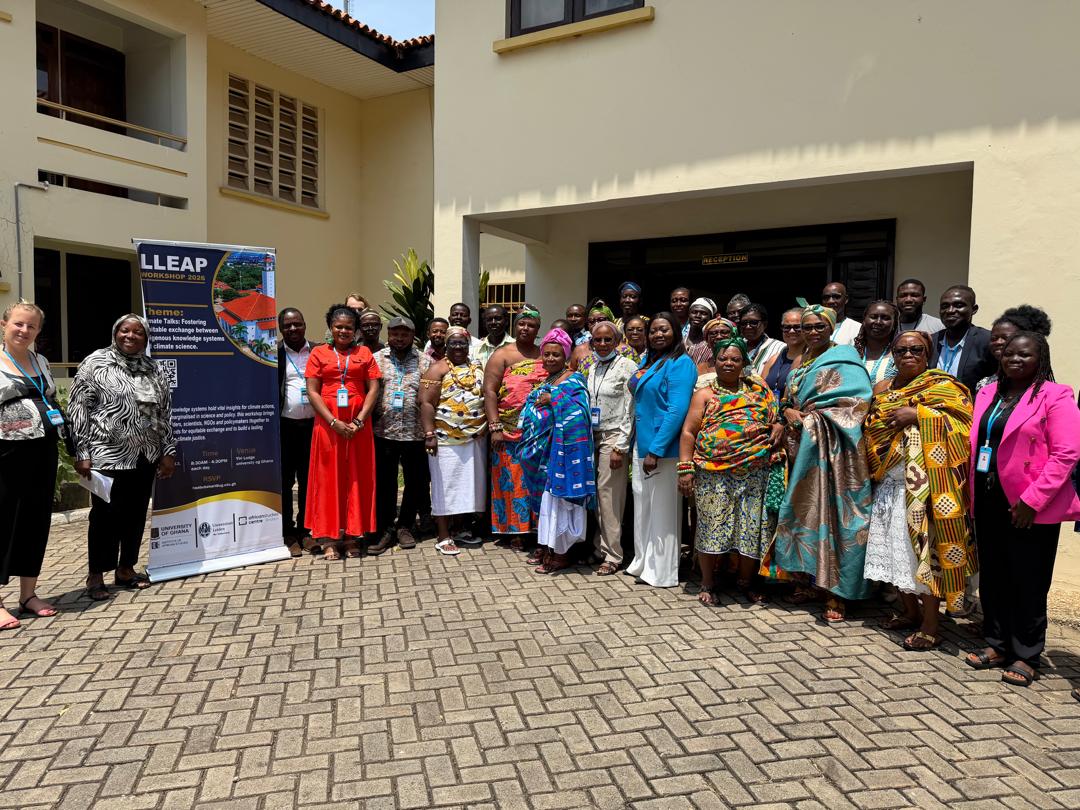 The Climate Talks project organised an impactful workshop from 12 to 14 October 2026, led by Sara de Wit (Leiden University) and Hasiyatu Abubakari (University of Ghana), and centred on equitable exchange between Indigenous Knowledge Systems (IKS) and climate science. It brought together researchers, traditional leaders, local practitioners, policymakers, and traditional knowledge holders including farmers, fishermen, queen mothers, medical herbalists and rainmakers in Ghana. Participants explored knowledge plurality, environmental justice, and practical climate adaptation.
Nature-based solutions
The first day focused on Indigenous and local knowledge, science, and climate justice. Workshop participants established the imperative for epistemic justice and called for a move beyond tokenism in climate policy. The keynote address by Professor Kwasi Appeaning Addo (University of Ghana) addressed severe coastal erosion, flooding, and nature-based solutions like mangrove restoration and beach nourishment. Panels examined critical mineral governance (such as lithium mining), community-based resource management (CREMAs), fisheries protection, and integrating local environmental indicators into disaster risk management and climate adaptation.
Ecological archives
The next day revolved around knowledge plurality, equitable co-production, and planetary health justice. This day featured a live rainmaking demonstration showcasing traditional environmental rituals. Presentations highlighted traditional medicine and phytomedicine for public health resilience, alongside marginalised gender perspectives in resource governance and ecological shifts following dam construction. Discussions also examined eco-linguistics, demonstrating how folktales, songs, and oral traditions serve as ecological archives carrying ethical lessons on environmental stewardship.
Co-designing climate interventions
A brainstorming session on day three proved very useful for building a knowledge consortium for future funding applications. Participants synthesised cross-cutting themes, emphasising that climate data must be paired with traditional moral compasses. Discussions focused on bridging academic research with policy implementation, establishing collaborative consortiums, and ensuring research actively benefits source communities. Key recommendations included co-designing climate interventions with traditional authorities, engaging key government ministries, and disseminating findings through public media.
Early-warning indicators
The workshop was followed by a field trip to Agavedzi, Volta Region. The team met with the Chief, Queen Mother, a rainmaker, a rainstopper, chief fisherman and fishers. Community leaders detailed severe coastal erosion, rising sea levels, and depleted fish stocks caused by industrial trawlers. Local custodians shared ancestral early-warning indicators such as wind patterns, sky observations, and animal behaviours while advocating for combined scientific and traditional interventions, such as beach nourishment and reclaimed housing for displaced families.
Watch a video about the workshop (filmed by Luca Lange).
Posted on 30 October 2026, last modified on 30 October 2026